 19 Views
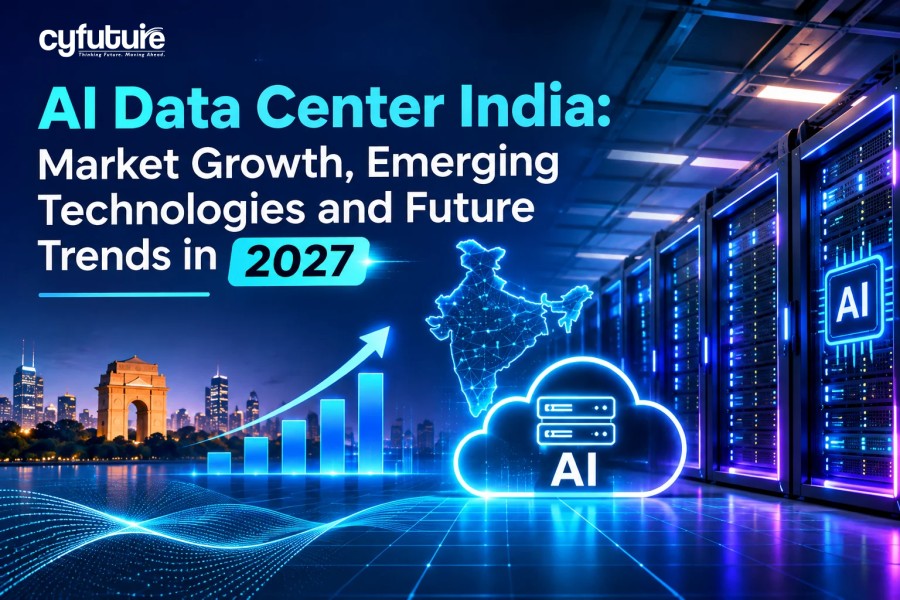
Artificial Intelligence (AI) is transforming industries across India, from healthcare and banking to manufacturing, telecommunications and e-commerce. Behind this transformation is a powerful digital infrastructure that enables organisations to process massive datasets, train machine learning models and deploy AI applications at scale. AI data centres are becoming a critical part of this infrastructure.
The growing adoption of generative AI, large language models (LLMs), machine learning and high-performance computing (HPC) is increasing the demand for advanced data centre facilities across the country. Unlike conventional data centres, AI-focused facilities are designed to support GPU-intensive workloads, high-density computing, faster data processing, and advanced cooling technologies.
India is emerging as an important destination for AI infrastructure investments, supported by digital transformation, cloud adoption, government initiatives and increasing enterprise demand.
According to the Ministry of Electronics and Information Technology (MeitY), India’s installed data centre capacity increased from approximately 375 MW in 2020 to around 1,575 MW by August 2026. This growth highlights the country’s expanding digital infrastructure requirements.
As we approach 2027, AI data centres in India are expected to play an increasingly important role in strengthening the country’s AI ecosystem and digital economy.
Let’s explore the market growth, emerging technologies, major applications and future trends shaping India’s AI data centre industry.
An AI data centre is a specialised computing facility designed to handle artificial intelligence workloads, including model training, inference, deep learning, neural network processing and large-scale data analytics.
Traditional data centres primarily support websites, enterprise applications, databases and cloud storage. In contrast, AI data centres require significantly more computing power, advanced processors and specialised infrastructure.
These facilities typically include:
GPU Infrastructure: High-performance GPUs such as NVIDIA H100, H200 and Blackwell-series accelerators for AI training and inference.
High-Speed Networking: Advanced networking technologies that enable faster communication between GPUs and computing nodes.
Advanced Cooling Systems: Liquid cooling, direct-to-chip cooling and immersion cooling to manage high thermal loads.
High-Density Racks: Infrastructure designed to support power-intensive AI computing equipment.
Enterprise-Grade Security: Physical security, network protection, access controls and data governance.
Scalable Storage: High-performance storage systems for handling large AI datasets and model checkpoints.
Together, these technologies enable businesses to develop, train and deploy AI applications more efficiently.
India’s data centre industry is experiencing significant expansion due to increasing digital consumption, enterprise cloud adoption and AI investments.
According to Cushman & Wakefield’s India Data Centre H1 2026 update, India’s operational data centre capacity reached approximately 1,789 MW by the first half of 2026. The development pipeline was nearly 3,860 MW, including projects under construction and in the planning stage.
Similarly, JLL’s 2026 mid-year report highlights the potential for India’s data centre capacity to increase from approximately 1.6 GW in mid-2026 to 6 GW by 2029.
These projections demonstrate the growing importance of India as a destination for digital and AI infrastructure.
1. Increasing AI and Machine Learning Adoption
Businesses are increasingly deploying generative AI, predictive analytics, automation and intelligent applications. These technologies require high-performance computing resources and specialised GPU infrastructure.
2. Growing Cloud Computing Demand
Organisations are migrating their workloads to cloud environments to improve flexibility, scalability and operational efficiency. This is increasing demand for cloud-ready and AI-ready data centres.
3. Government Support and Digital Initiatives
Government initiatives supporting AI development, digital infrastructure and data centre investments are creating opportunities for domestic and international technology providers.
The Union Budget 2026–27 also proposed a tax holiday until 2047 for eligible foreign cloud service providers using India-based data centre infrastructure for global operations.
4. Enterprise Digital Transformation
Banking, financial services, healthcare, retail and manufacturing companies are investing in AI-driven solutions. These applications require secure, reliable and scalable computing infrastructure.
5. Growing Demand for Data Sovereignty
Organisations are increasingly evaluating where their data is stored and processed. Domestic infrastructure can help businesses address applicable data protection, security and regulatory requirements.
India’s data centre ecosystem is expanding across established technology and commercial locations.
The following cities are particularly important for the development of AI and cloud infrastructure.
Mumbai is India’s largest established data centre market. Its connectivity, submarine cable infrastructure, financial services ecosystem and enterprise demand make it an important location for hyperscale and AI infrastructure.
Delhi NCR is an important destination for enterprise cloud services, government workloads, financial services and digital businesses.
Noida offers opportunities for data centre development due to its connectivity, technology ecosystem and proximity to major enterprise customers.
Chennai benefits from its submarine cable connectivity and strategic location on India’s eastern coastline. It is an important market for cloud infrastructure, international connectivity and hyperscale facilities.
Bengaluru’s technology ecosystem, IT companies, startups and AI research activities make it a significant destination for advanced computing infrastructure.
Hyderabad is attracting data centre investments due to its technology ecosystem, infrastructure development and availability of opportunities for large-scale projects.
These markets are expected to remain important as India expands its AI computing and digital infrastructure capabilities.
The next generation of AI data centres will focus on computing performance, energy efficiency, scalability and intelligent infrastructure management.
Here are some major technologies expected to influence the industry in 2027.
Graphics Processing Units (GPUs) are essential for training and running modern AI models.
Unlike traditional CPUs, GPUs can perform thousands of parallel computations, making them suitable for deep learning, generative AI and large language models.
Advanced GPU platforms, including NVIDIA H100, H200 and Blackwell-based systems, are helping organisations handle demanding AI workloads.
Businesses can use GPU cloud infrastructure to access high-performance computing resources without investing in an entire physical GPU data centre.
AI workloads generate substantial heat because of high-density GPU deployments.
Traditional air cooling may become less efficient when racks operate at very high power densities.
Advanced cooling technologies include:
Direct-to-chip liquid cooling
Immersion cooling
Closed-loop liquid cooling
Rear-door heat exchangers
Adiabatic cooling
These technologies can improve thermal management and support higher-density computing environments.
The Indian government has also highlighted advanced cooling technologies as an important part of reducing data centre energy and water requirements.
AI model training often requires multiple GPUs and computing nodes to communicate continuously.
High-speed networking technologies such as InfiniBand and high-performance Ethernet help reduce communication bottlenecks and improve distributed computing performance.
In 2027, advanced networking will become increasingly important for large-scale AI training clusters.
Edge computing brings data processing closer to the location where data is generated.
This approach can reduce latency and improve response times for applications such as:
Autonomous systems
Industrial automation
Smart manufacturing
Connected healthcare
Smart cities
Real-time video analytics
Edge AI infrastructure will complement centralised data centres by supporting applications that require faster local processing.
Artificial intelligence is also transforming the way data centres operate.
AI-powered management systems can analyse infrastructure performance, identify potential equipment failures, optimise cooling operations and monitor energy consumption.
Predictive maintenance and intelligent workload scheduling can help improve operational efficiency and infrastructure availability.
AI data centres support several industries by providing the computing infrastructure required for advanced AI applications.
Healthcare organisations can use AI infrastructure for medical image analysis, predictive diagnostics, medical research and drug discovery.
High-performance computing helps process complex medical datasets and supports AI-assisted healthcare applications.
Banks and financial institutions use AI for fraud detection, risk assessment, customer analytics and automated financial services.
AI data centres provide the computing resources needed to process large volumes of financial information securely.
Manufacturers are adopting AI-powered quality inspection, predictive maintenance, robotics and production optimisation.
AI infrastructure helps process operational data and improve manufacturing efficiency.
Retail businesses use AI for personalised recommendations, demand forecasting, inventory management and customer behaviour analysis.
Scalable AI computing infrastructure supports these applications during periods of high demand.
Telecom operators use AI for network optimisation, traffic forecasting, predictive maintenance and customer experience management.
AI-enabled data centres help process large amounts of network-generated information.
Despite strong growth opportunities, developing AI-ready data centres involves several infrastructure challenges.
High Energy Consumption: AI computing requires substantial electricity, making reliable power availability and energy efficiency essential.
Cooling Requirements: High-density GPU infrastructure generates significant heat, requiring specialised cooling systems and careful water management.
Infrastructure Investment: Building AI data centres involves substantial capital expenditure for land, buildings, power systems, GPUs, networking and cooling equipment.
Skilled Workforce: Operating advanced AI infrastructure requires expertise in cloud computing, data centre engineering, GPU management, cybersecurity and high-performance networking.
Data Security and Compliance: AI infrastructure providers must implement appropriate security controls and comply with applicable data protection and industry-specific requirements.
Addressing these challenges will be essential for India’s long-term AI infrastructure development.
The Indian AI data centre market is expected to experience further technological and infrastructure transformation in 2027.
Here are seven important trends to watch.
1. Expansion of GPU Cloud Infrastructure
Demand for GPU cloud services is expected to increase as startups, enterprises and research institutions require affordable access to high-performance computing.
2. Growth of Hyperscale AI Data Centres
Large-scale facilities will support cloud platforms, generative AI applications and enterprise AI workloads.
3. Increasing Adoption of Green Data Centres
Renewable energy, efficient power systems and sustainable cooling solutions will become increasingly important for operators.
4. Greater Investment in Liquid Cooling
As GPU rack densities increase, liquid cooling technologies will become more important for maintaining reliable operating temperatures.
5. Growth of AI Inference Infrastructure
The deployment of AI applications will increase demand for inference infrastructure that can deliver model responses efficiently and at scale.
6. Increased Focus on Data Sovereignty
Businesses will continue evaluating domestic infrastructure options to address data governance, security and applicable regulatory requirements.
7. Integration of AI and Automation
Intelligent infrastructure monitoring, predictive maintenance and automated resource management will help improve data centre operations.
Selecting the right AI data centre provider is important for organisations planning to deploy AI workloads.
Before choosing an infrastructure partner, consider the following factors:
GPU Availability: Check support for the GPU configurations required by your AI workloads.
Power Infrastructure: Evaluate power redundancy, availability and capacity for high-density computing.
Cooling Technology: Verify whether the facility supports advanced cooling requirements.
Network Connectivity: Look for reliable connectivity and low-latency networking.
Security: Evaluate physical security, cybersecurity controls and compliance capabilities.
Scalability: Ensure the provider can support future increases in computing requirements.
Technical Support: Consider infrastructure monitoring, maintenance and technical assistance.
Pricing Flexibility: Compare dedicated infrastructure, GPU cloud and managed service pricing models.
A suitable AI infrastructure partner can help organisations reduce deployment complexity and build a scalable foundation for AI innovation.
India’s AI data centre industry is moving towards a new phase of infrastructure development. Increasing AI adoption, enterprise digital transformation, cloud computing and government initiatives are creating significant opportunities for advanced computing facilities.
In 2027, GPU-powered infrastructure, liquid cooling, AI-driven operations, edge computing and sustainable energy solutions are expected to influence the next generation of data centres.
For businesses, investing in the right AI infrastructure will be essential for developing intelligent applications, improving operational efficiency and remaining competitive in an increasingly AI-driven economy.
Organisations looking for scalable computing resources can explore AI-ready data centre infrastructure, GPU cloud services and enterprise cloud solutions from providers such as Cyfuture.
An AI data centre is a specialised facility designed to support artificial intelligence workloads, including machine learning, deep learning, generative AI, model training and inference using high-performance computing infrastructure.
Demand is increasing because of generative AI adoption, cloud computing, enterprise digital transformation, GPU-intensive workloads and government initiatives supporting AI development.
Mumbai, Navi Mumbai, Chennai, Hyderabad, Bengaluru and Delhi NCR are among India’s major data centre markets.
AI data centres use high-performance GPUs, advanced networking, high-density racks, liquid cooling, scalable storage, intelligent monitoring and enterprise-grade security systems.
GPUs accelerate parallel computing operations required for training machine learning models, running large language models, deep learning and AI inference applications.
The industry is expected to see increased GPU infrastructure deployment, hyperscale expansion, advanced liquid cooling, renewable energy adoption, edge AI and AI-powered infrastructure management.
The major challenges include electricity consumption, cooling requirements, infrastructure investment, GPU availability, skilled workforce requirements and data security.
Businesses can access AI infrastructure through colocation facilities, dedicated GPU servers, GPU cloud platforms and managed infrastructure services, depending on their workload and computing requirements.