 15 Views
Artificial intelligence is changing how Indian businesses build products, manage operations and compete in their respective industries. From generative AI applications and intelligent automation to large language models (LLMs), computer vision and predictive analytics, organisations are increasingly investing in AI technologies to improve efficiency and develop new capabilities.
However, building an effective AI solution requires more than choosing an algorithm or developing an application. Behind every production-ready AI system is an infrastructure layer that provides the computing power, GPU resources, storage, networking, cloud platforms and data centre facilities needed to train, deploy and operate AI models.
This growing demand is creating significant opportunities for AI infrastructure companies in India. Businesses are looking beyond conventional cloud hosting and exploring specialised GPU cloud platforms, high-performance computing environments, AI-ready data centres and managed AI services.
India’s infrastructure expansion reflects this shift. According to Cushman & Wakefield’s India Data Centre H1 2026 update, the country’s operational data centre capacity reached approximately 1,789 MW by the first half of 2026, with an additional development pipeline of around 3,860 MW through 2030.
The IndiaAI Mission is also strengthening access to computing resources. Government figures published in August 2026 reported that shared AI compute capacity had expanded to more than 45,000 GPUs, helping startups, researchers and enterprises access computing resources without investing in their own GPU infrastructure.
As these developments accelerate, selecting the right infrastructure partner becomes an important business decision.
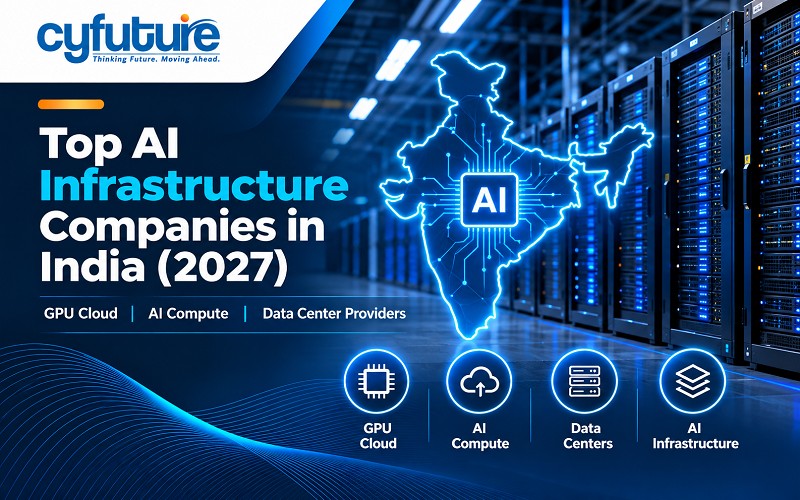
In this guide, we explore the top AI infrastructure companies in India for 2027, examining their GPU cloud capabilities, AI computing environments, data centre infrastructure and services that help organisations move from AI experimentation to real-world deployment.
India’s AI infrastructure market is expanding because organisations need computing environments capable of handling increasingly demanding workloads. Conventional CPU-based cloud servers remain useful for business applications, but training and running modern AI models often requires specialised hardware, high-speed networking and optimised storage.
Three developments are particularly important.
GPUs have become essential for training deep learning models, fine-tuning LLMs, running generative AI applications and processing large datasets.
The demand is not limited to technology companies. Financial institutions, healthcare organisations, manufacturing companies, retailers and government departments are also adopting GPU-powered applications.
This is creating demand for GPU-as-a-Service (GPUaaS), where businesses rent computing resources instead of purchasing and maintaining expensive GPU servers.
Traditional data centres were primarily designed around conventional enterprise servers, storage and networking. AI workloads introduce additional infrastructure requirements, including:
According to Cushman & Wakefield, India’s data centre development pipeline reached approximately 3,860 MW by the first half of 2026. The country is also expected to require around US$29.9 billion in data centre development capital through 2030.
Cushman & Wakefield
The IndiaAI Mission, approved with an allocation of approximately ₹10,372 crore, is an important part of India’s strategy to expand domestic AI capabilities.
By June 2026, the government reported more than 45,000 GPUs in its shared AI computing ecosystem. This infrastructure is intended to improve access to high-performance computing for startups, academic institutions, researchers and businesses.
Together, these developments are creating opportunities for Indian companies offering GPU cloud, AI infrastructure, data centre and managed AI services.
The following companies represent different parts of India’s AI infrastructure ecosystem. The selection considers AI compute capabilities, GPU cloud services, data centre infrastructure, enterprise cloud offerings, technology partnerships and relevance to AI deployment.
This is an editorial shortlist, not an official market-share ranking. The companies are not direct substitutes for one another: some specialise in GPU cloud, while others focus on hyperscale data centres, colocation or integrated technology infrastructure.
Cyfuture is an Indian technology and infrastructure provider building capabilities across GPU cloud, AI computing, enterprise cloud and data centre infrastructure. Through its Cyfuture AI platform, the company addresses the growing demand for accessible GPU resources and integrated AI deployment environments.
What makes Cyfuture particularly relevant to India’s AI infrastructure market is its focus on connecting the physical infrastructure layer with the computing and application layers. Businesses can explore GPU resources, AI platforms and supporting infrastructure without treating every component as a separate technology project.
Key AI infrastructure and cloud capabilities
Cyfuture’s infrastructure strategy also connects data centre facilities, accelerated computing, cloud platforms and AI services. Its data centre portfolio includes locations such as Noida, Jaipur and Bangalore, while its AI infrastructure capabilities are designed around the requirements of GPU-intensive workloads.
An important aspect of this approach is the combination of infrastructure and AI services. An organisation developing a generative AI application, for example, may need GPU resources for model fine-tuning, an inference environment for deployment, a RAG platform for accessing internal documents and a chatbot interface for end users.
Instead of sourcing each capability independently, businesses can evaluate an integrated platform approach.
Cyfuture is worth considering for organisations looking for an India-based AI infrastructure partner that offers more than conventional cloud hosting. Its combination of GPUaaS, AI compute, inference services, RAG capabilities and enterprise infrastructure makes it relevant to startups, SaaS companies, research teams and enterprises developing AI-powered products.
For organisations evaluating domestic GPU cloud providers, Cyfuture is particularly relevant when data location, workload flexibility, GPU availability and integrated AI deployment capabilities are important selection criteria.
Best suited for: AI startups, enterprises, developers, SaaS platforms, research institutions and businesses looking for GPU cloud, AI compute and integrated AI services in India.
Yotta Data Services is an important participant in India’s hyperscale data centre and AI computing ecosystem. The company provides data centre, cloud and GPU computing infrastructure for organisations that require substantial computing capacity.
Its Shakti Cloud platform is focused on accelerated computing for AI development, model training and inference.
Yotta has also been associated with India’s sovereign AI infrastructure development, including large-scale NVIDIA GPU deployments. NVIDIA has highlighted Yotta’s Shakti Cloud as an infrastructure platform powered by more than 20,000 NVIDIA Blackwell Ultra GPUs.
Key AI infrastructure capabilities
Yotta’s combination of data centre capacity and GPU cloud infrastructure makes it relevant to organisations developing large-scale AI workloads.
Best suited for: Large enterprises, AI model developers, government projects and organisations requiring hyperscale GPU computing.
E2E Networks has established a presence in India’s cloud computing ecosystem, with a particular focus on GPU-powered infrastructure and high-performance computing.
Its TIR platform supports GPU-based AI and machine learning workloads. The company has also been highlighted by NVIDIA for its participation in India’s AI infrastructure development, including work involving NVIDIA Blackwell GPU systems hosted at an L&T data centre.
Key AI infrastructure capabilities
E2E Networks is relevant to businesses that need cloud-based GPU resources without purchasing dedicated physical hardware.
Best suited for: AI developers, startups, technology companies and organisations requiring scalable GPU computing.
Neysa focuses on AI cloud infrastructure, GPU computing and enterprise AI deployment. Its services address the infrastructure requirements of organisations building and operating machine learning models, generative AI applications and high-performance computing workloads.
As AI adoption increases, enterprises need more than access to individual GPUs. They also require computing environments that can support workload orchestration, infrastructure management and scaling.
Neysa’s AI infrastructure offering addresses these requirements through GPU-focused cloud environments and enterprise-oriented deployment options.
Key AI infrastructure capabilities
Best suited for: Enterprises, AI-first businesses, research organisations and companies deploying large-scale machine learning workloads.
CtrlS Datacenters is an established Indian data centre operator serving enterprises, cloud providers and technology organisations.
The company focuses on hyperscale and enterprise data centre infrastructure, providing the physical foundation required to host servers, cloud environments and business-critical applications.
As GPU-intensive AI workloads become more common, data centre characteristics such as power availability, rack density, cooling infrastructure, connectivity and redundancy are becoming increasingly important.
Key infrastructure capabilities
CtrlS is particularly relevant for organisations that require secure and reliable facilities to deploy their own AI servers or enterprise computing infrastructure.
Best suited for: Large enterprises, cloud providers, financial institutions and organisations requiring colocation or dedicated data centre infrastructure.
Sify Technologies is an established Indian enterprise technology company operating across data centres, cloud computing, network services and managed IT infrastructure.
Its broad infrastructure portfolio is relevant to organisations that need connectivity, computing and hosting services to support digital transformation and AI adoption.
AI workloads depend on reliable data movement between storage, GPU servers, applications and end users. This makes network infrastructure an important part of an AI deployment strategy.
Key infrastructure capabilities
Sify’s integrated approach to cloud, connectivity and data centre services makes it a relevant infrastructure partner for businesses modernising their IT environments.
Best suited for: Enterprises, financial services organisations, large businesses and companies seeking integrated network and cloud infrastructure.
Nxtra by Airtel operates data centre infrastructure supporting enterprise cloud, colocation and digital services.
The company’s connection with Airtel’s telecommunications and connectivity ecosystem is relevant to businesses that require reliable infrastructure and network access.
As AI applications become increasingly distributed, organisations need data centres capable of supporting high-performance servers, large datasets and reliable connections between computing resources.
Key infrastructure capabilities
Nxtra is an option for organisations evaluating enterprise data centre infrastructure in India, particularly where connectivity and facility reliability are important.
Best suited for: Enterprises, telecommunications companies, cloud providers and organisations requiring colocation and data centre services.
STT GDC India is part of the global ST Telemedia Global Data Centres network. It provides data centre infrastructure for cloud providers, enterprises and digital businesses.
Its role in India’s infrastructure market is centred on facilities designed to support enterprise hosting, colocation and hyperscale requirements.
For AI infrastructure deployments, colocation providers such as STT GDC can be important because organisations may prefer to own their GPU servers while leasing the required power, space, cooling and connectivity.
Key infrastructure capabilities
Best suited for: Enterprises, cloud providers, hyperscalers and businesses deploying dedicated hardware in professionally managed data centres.
L&T is expanding its digital infrastructure presence through L&T Vyoma, with a focus on cloud computing, sovereign infrastructure and AI factories.
The company’s AI infrastructure ambitions are significant because AI factories require coordinated investment in computing hardware, electrical systems, cooling, networking and data centre operations.
NVIDIA has identified L&T among the companies collaborating to develop advanced AI infrastructure in India. Its announced infrastructure roadmap includes capacity expansion in Chennai and Mumbai.
NVIDIA Blog
Key AI infrastructure capabilities
Best suited for: Government organisations, large enterprises, hyperscalers and businesses requiring sovereign cloud and large-scale AI infrastructure.
Netweb Technologies plays a different but important role in India’s AI infrastructure ecosystem. Rather than focusing primarily on GPU cloud rentals or colocation, the company is involved in designing and supplying advanced computing systems.
Its portfolio includes high-performance computing, AI systems, enterprise servers and supercomputing infrastructure.
The company has also been highlighted for its NVIDIA Grace Blackwell-based computing systems, including platforms designed for advanced AI and scientific computing applications.
NVIDIA Blog
Key AI infrastructure capabilities
Netweb is particularly relevant for organisations that prefer to deploy and operate their own AI hardware instead of relying entirely on cloud-based GPU resources.
Best suited for: Research institutions, government organisations, enterprises and businesses building dedicated AI computing infrastructure.
Choosing an infrastructure provider depends on whether a business needs GPU computing, enterprise cloud, AI-ready data centres or dedicated hardware.
The following comparison provides a practical overview of the companies discussed.
| Company | Primary specialisation | Relevant infrastructure services |
| Cyfuture | AI infrastructure and GPU cloud | GPUaaS, GPU clusters, inference, RAG, AI platforms |
| Yotta | Hyperscale AI infrastructure | Shakti Cloud, GPU compute, data centres |
| E2E Networks | GPU cloud | AI compute, GPU instances, HPC |
| Neysa | Enterprise AI cloud | GPU infrastructure, AI training and inference |
| CtrlS | Data centre infrastructure | Hyperscale colocation, managed facilities |
| Sify Technologies | Enterprise cloud and connectivity | Cloud, data centres, network services |
| Nxtra by Airtel | Data centre infrastructure | Colocation, hyperscale facilities, connectivity |
| STT GDC India | Hyperscale colocation | Data centres, enterprise hosting |
| L&T Vyoma | Sovereign AI infrastructure | AI factories, cloud, data centres |
| Netweb Technologies | AI hardware and HPC | GPU servers, supercomputing systems |
Note: This is a qualitative comparison of service portfolios, not a comparison of independently audited GPU capacity or market share. Individual GPU models, locations and availability should be confirmed with providers.
Traditional cloud providers offer computing, storage, networking and application hosting. AI infrastructure providers go a step further by designing environments specifically for the performance and resource requirements of artificial intelligence workloads.
There are several important differences.
| Infrastructure component | Traditional cloud environment | AI infrastructure environment |
| Computing | General-purpose CPUs | GPUs and accelerated computing |
| Workloads | Websites, applications, databases | LLM training, inference, deep learning |
| Networking | Standard cloud networking | High-bandwidth, low-latency GPU interconnects |
| Storage | General-purpose block and object storage | High-throughput AI datasets and NVMe storage |
| Cooling | Conventional server cooling | Advanced cooling for high-density GPU racks |
| Scaling | Virtual machine and container scaling | GPU cluster and distributed compute scaling |
| Software | General-purpose cloud management | AI frameworks, model serving and GPU orchestration |
An organisation training a large language model, for example, may need multiple GPUs connected through high-speed networking. A business running a customer-support chatbot may require a smaller GPU environment optimised for inference.
This is why selecting an AI infrastructure provider should begin with understanding the workload rather than simply comparing server specifications.
Not every AI infrastructure provider is suitable for every business. A startup experimenting with open-source models has different requirements from a financial institution deploying production-grade generative AI applications.
Before selecting a provider, consider the following factors.
GPU availability is one of the first things to evaluate.
Check which GPU models are available, whether they can be rented on demand, and whether the provider supports multi-GPU configurations.
For example:
The right GPU depends on model size, memory requirements, training duration and expected inference throughput.
Where AI workloads are hosted can influence application latency, regulatory requirements and data governance.
Indian businesses handling financial, healthcare, government or other sensitive information may need to evaluate domestic hosting options and applicable data protection obligations.
Look for providers with clearly documented facility locations, security practices, access controls and compliance certifications.
GPU infrastructure is not just about the number of GPUs installed in a server.
When multiple GPUs work together, communication between accelerators becomes important. Slow interconnects can create bottlenecks and reduce the efficiency of distributed training.
Evaluate networking technologies, bandwidth, latency, GPU interconnects and storage throughput before committing to a large deployment.
AI computing systems consume significant electricity and generate substantial heat.
High-density GPU deployments may require advanced cooling technologies, including direct-to-chip liquid cooling or immersion cooling, depending on rack density and facility design.
Businesses should evaluate:
Infrastructure is only one part of the AI development process.
Developers may also need access to machine learning frameworks, model libraries, container orchestration, inference engines, vector databases and model monitoring tools.
An infrastructure provider offering these capabilities can simplify the transition from model development to production deployment.
GPU infrastructure costs can vary considerably depending on GPU type, configuration, utilisation and deployment duration.
Compare hourly, monthly and reserved capacity options. Also examine storage charges, networking costs, support fees and minimum commitments.
A lower hourly GPU price does not necessarily mean a lower overall cost. The actual value depends on performance, utilisation and the time required to complete a workload.
India’s AI infrastructure ecosystem is entering a new phase. The next stage of growth will depend not just on adding servers but on building integrated environments that can support increasingly complex AI applications.
Here are five developments worth watching.
GPUaaS is making advanced computing more accessible to startups and enterprises.
Instead of purchasing expensive hardware, organisations can rent GPU resources according to their workload requirements. This reduces upfront infrastructure expenditure and gives development teams more flexibility.
As demand for generative AI increases, GPU cloud services are likely to remain an important part of India’s computing ecosystem.
Data sovereignty and domestic computing capabilities are becoming important considerations for Indian businesses and government organisations.
The IndiaAI Mission is helping expand access to domestic compute resources, while infrastructure providers are developing India-hosted GPU cloud and AI computing environments.
This development is particularly relevant to organisations working with sensitive datasets and applications that require greater control over infrastructure location.
Modern GPU systems have higher power and thermal requirements than many traditional enterprise servers.
As rack densities increase, conventional air cooling can become less suitable for certain deployments. Direct-to-chip liquid cooling and other advanced thermal management technologies are gaining importance.
The next generation of AI-ready data centres will need to coordinate power, cooling, compute and networking at the design stage.
AI infrastructure requirements do not end when model training is complete.
Businesses need computing resources to serve models to customers, employees and applications. This is known as inference.
With increasing adoption of AI agents, chatbots, voicebots and enterprise copilots, inference infrastructure will become an important area of investment.
Providers offering serverless inference, dedicated GPU inference and model-serving platforms will be relevant to businesses moving AI applications into production.
The AI factory concept brings together the physical and digital infrastructure required to produce intelligence at scale.
It combines:
Rather than treating the data centre and cloud as separate investments, AI factories approach them as interconnected parts of one computing environment.
This model is expected to influence how large enterprises, hyperscalers and infrastructure companies plan their future AI deployments.
AI adoption is moving beyond experimentation. Businesses are increasingly looking to integrate AI into customer service, internal operations, analytics, product development and decision-making.
However, deploying AI at scale requires infrastructure that can support changing workloads without creating unnecessary operational complexity.
For startups, GPU cloud can reduce the need for upfront hardware investment. For enterprises, dedicated computing environments can offer greater control over performance, security and deployment architecture. For organisations building their own AI products, access to model libraries, inference platforms and RAG infrastructure can shorten development cycles.
The right AI infrastructure company should therefore offer more than computing resources. It should understand the complete AI lifecycle, from infrastructure provisioning and model development to deployment and ongoing operations.
For Indian businesses, working with an infrastructure provider that understands domestic data centre requirements, GPU availability, enterprise workloads and local deployment considerations can be particularly valuable.
Some notable companies in India’s AI infrastructure ecosystem include Cyfuture, Yotta Data Services, E2E Networks, Neysa, CtrlS, Sify Technologies, Nxtra by Airtel, STT GDC India, L&T Vyoma and Netweb Technologies. They offer different combinations of GPU cloud, AI computing, data centre, enterprise cloud and hardware services.
The best provider depends on the business requirement. Cyfuture is a relevant option for organisations looking for an integrated combination of GPU cloud, AI compute, model inference, RAG and enterprise AI services. Yotta and E2E Networks are also relevant for GPU-focused computing, while CtrlS, Sify and STT GDC offer data centre infrastructure.
AI infrastructure services include GPU computing, cloud infrastructure, high-performance networking, storage, data centre hosting, model training environments, AI inference platforms and infrastructure management. These services provide the technical foundation for developing, training and deploying artificial intelligence applications.
GPU as a Service is a cloud computing model that allows businesses and developers to rent GPU resources rather than purchase and maintain physical GPU servers. It provides access to accelerated computing for machine learning, deep learning, LLM training, fine-tuning and AI inference.
Cyfuture, Yotta Data Services, E2E Networks and Neysa are among the Indian providers offering GPU-focused cloud or AI computing infrastructure. GPU availability, configurations, pricing and deployment locations vary by provider and should be confirmed before deployment.
The IndiaAI Mission is a government initiative approved with an allocation of approximately ₹10,372 crore to strengthen India’s AI ecosystem. It supports shared AI computing infrastructure, indigenous AI model development, datasets, research and AI innovation. By June 2026, the government reported more than 45,000 GPUs in its shared compute ecosystem.
A traditional data centre generally supports enterprise servers, databases, storage and cloud applications. An AI data centre is designed to accommodate specialised computing requirements, including high-density GPU servers, advanced cooling, high-bandwidth networking and high-performance storage.
GPU cloud pricing depends on the GPU model, memory configuration, number of GPUs, deployment duration and service provider. Some providers offer hourly rental plans, while enterprise deployments may use monthly or reserved-capacity pricing. Businesses should compare the total workload cost rather than GPU hourly rates alone.
Liquid cooling helps remove heat from high-density computing systems more efficiently in suitable deployments. It is particularly useful for advanced GPU infrastructure where thermal management and power density can become major operational considerations.
Enterprises should evaluate GPU availability, computing performance, data centre locations, security certifications, data residency, networking, cooling, storage, technical support, scalability and pricing. They should also assess whether the provider supports the complete AI lifecycle, including training, fine-tuning, inference and application deployment.
India’s AI ecosystem is moving towards a more infrastructure-driven phase of growth. The expansion of GPU computing, sovereign AI initiatives, hyperscale data centres and advanced cloud platforms is creating opportunities for businesses to develop and deploy AI applications at scale.
The companies featured in this article represent different capabilities across this ecosystem. Some focus on hyperscale data centres, others specialise in GPU cloud and accelerated computing, while technology companies are developing the hardware and platforms needed for advanced AI workloads.
Cyfuture stands out as an option for organisations looking to bring GPU infrastructure, AI computing and application deployment capabilities together. Through Cyfuture AI, businesses can explore GPU as a Service, GPU clusters, AI inferencing, RAG infrastructure, AI models and enterprise AI solutions.
As AI adoption grows in India, choosing the right infrastructure partner will be an important factor in controlling costs, improving computing performance and taking AI projects from experimentation to production.
Businesses planning their next AI deployment should evaluate their computing requirements today and select infrastructure that can support their long-term growth.
Ready to build and scale your AI workloads in India?
Explore Cyfuture’s GPU Cloud and AI Infrastructure Services or connect with Cyfuture to discuss your AI computing and infrastructure requirements.