 395 Views
As artificial intelligence (AI), machine learning (ML), deep learning, and high-performance computing (HPC) continue to reshape industries, organizations are increasingly relying on cloud-based infrastructure to power their digital transformation initiatives. Traditionally, businesses have turned to Cloud Service Providers (CSPs) for computing, storage, networking, and application hosting needs. However, the rapid growth of AI workloads has led to the emergence of a specialized category known as GPU Service Providers.
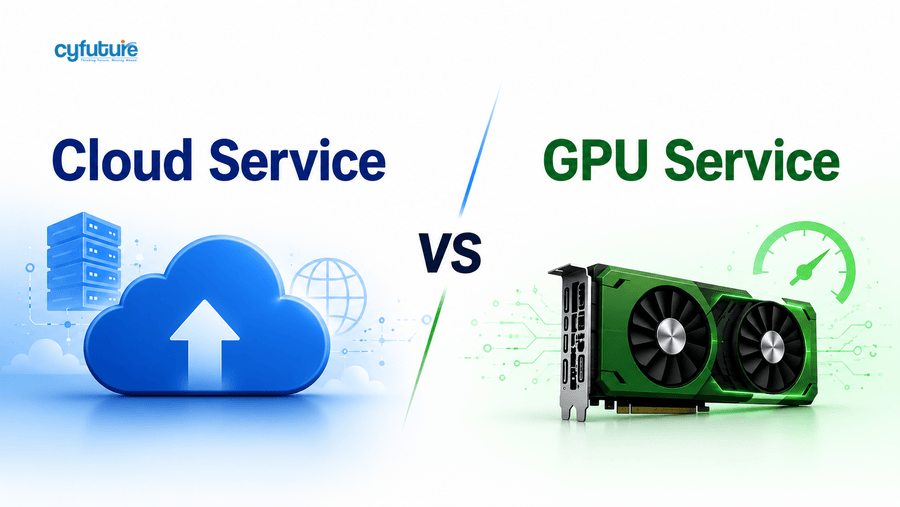
While both cloud service providers and GPU service providers offer computing resources through the cloud, their infrastructure, performance capabilities, pricing models, and use cases differ significantly. Understanding these differences is critical for businesses looking to optimize performance, reduce costs, and accelerate innovation.
This article explores the key distinctions between cloud service providers and GPU service providers, helping organizations determine which solution best aligns with their business objectives.
Cloud Service Providers (CSPs) are companies that deliver computing resources, software, storage, networking, databases, and other IT services over the internet. These providers enable organizations to access scalable infrastructure without investing heavily in on-premises hardware.
Common services offered by cloud providers include:
Popular cloud service providers include:
These providers serve a wide range of workloads, from web hosting and enterprise applications to big data analytics and software development.
Cloud providers allow businesses to scale resources up or down based on demand, eliminating the need for large capital investments.
Organizations pay only for the resources they consume, making cloud computing a cost-effective alternative to traditional infrastructure.
Most CSPs operate data centers worldwide, enabling low-latency access and improved disaster recovery capabilities.
Cloud platforms offer integrated ecosystems that support application development, analytics, storage, networking, and security.
GPU Service Providers specialize in delivering Graphics Processing Units (GPUs) through cloud-based infrastructure. Unlike traditional cloud providers that primarily focus on general-purpose computing, GPU providers optimize their environments for computationally intensive workloads.
GPUs excel at parallel processing, making them ideal for:
GPU service providers offer access to high-end NVIDIA GPUs such as:
These services allow businesses to leverage powerful GPU infrastructure without purchasing expensive hardware.
GPU clusters significantly reduce AI model training times compared to CPU-based infrastructure.
Thousands of GPU cores can process large datasets simultaneously, delivering exceptional performance.
GPU providers often include optimized networking, storage, and software frameworks designed specifically for AI workloads.
Businesses can quickly deploy AI projects without waiting for hardware procurement and installation.
The most significant difference lies in their primary purpose.
Cloud Service Providers
GPU Service Providers
Traditional cloud environments primarily rely on CPU-based servers.
Cloud Providers
GPU Providers
GPU service providers often deploy specialized AI infrastructure that outperforms standard cloud GPU instances for demanding workloads.
Performance requirements vary significantly between traditional applications and AI workloads.
For example:
A business application may require:
An AI model training project may require:
GPU providers deliver superior performance for AI, deep learning, and HPC tasks because their infrastructure is purpose-built for parallel computing.
Cost considerations differ substantially between the two models.
Typically charge based on:
Pricing often depends on:
Although GPU resources appear more expensive per hour, they often complete workloads significantly faster, resulting in lower overall project costs.
Most cloud providers now offer AI services and GPU instances.
However, GPU providers generally provide:
Organizations focused heavily on AI development often benefit from these specialized capabilities.
Cloud providers typically require users to configure infrastructure manually.
GPU service providers frequently offer:
This enables data science teams to begin model training almost immediately.
AI projects often require substantial computational resources.
Cloud providers can scale infrastructure effectively but may face GPU availability limitations during periods of high demand.
Specialized GPU providers often maintain dedicated AI infrastructure designed specifically for large-scale training workloads, making scaling more predictable.
Cloud service providers are ideal for businesses that need comprehensive IT infrastructure.
Organizations can host websites, applications, and e-commerce platforms efficiently.
Businesses can run ERP, CRM, HRMS, and productivity applications in the cloud.
Cloud storage solutions provide secure, scalable data management.
Developers can build, test, and deploy applications using cloud-native tools.
Cloud platforms help organizations maintain business continuity and data protection.
GPU service providers are best suited for compute-intensive applications.
Large language models require extensive GPU resources for training.
Applications involving text generation, image creation, and video synthesis depend heavily on GPU acceleration.
Data scientists use GPU infrastructure to train predictive models faster.
Image recognition and object detection workloads benefit significantly from parallel processing.
Researchers perform simulations, genomics analysis, and computational chemistry using GPU-powered environments.
Investment firms leverage GPU clusters for risk analysis and algorithmic trading.
Absolutely.
Many organizations adopt a hybrid approach.
For example:
A company may use a cloud service provider for:
At the same time, it may use a GPU service provider for:
This strategy allows businesses to optimize costs while leveraging specialized infrastructure where needed.
When evaluating cloud and GPU service providers, consider the following factors:
Determine whether your workloads are general-purpose or AI-intensive.
Identify latency, throughput, and processing requirements.
Compare total cost of ownership rather than hourly pricing alone.
Ensure the provider can support future growth.
Verify certifications, security controls, and regulatory compliance requirements.
Choose providers with expertise relevant to your workloads.
The demand for AI infrastructure is growing rapidly.
According to industry forecasts, global AI spending is expected to exceed hundreds of billions of dollars over the next decade. As organizations deploy larger AI models and increasingly complex workloads, GPU demand continues to surge.
Cloud providers are investing heavily in GPU infrastructure, while specialized GPU providers are expanding their offerings to include AI factories, liquid-cooled data centers, and advanced GPU clusters.
The future will likely see greater convergence between traditional cloud services and GPU-accelerated computing, creating more flexible and powerful infrastructure options for enterprises.
Cloud Service Providers and GPU Service Providers serve different but complementary roles in the modern technology ecosystem.
Cloud service providers offer versatile infrastructure suitable for a broad range of business applications, including storage, networking, application hosting, and enterprise workloads. GPU service providers, on the other hand, specialize in delivering high-performance computing resources optimized for AI, machine learning, deep learning, and advanced analytics.
For organizations focused on digital transformation, understanding these differences is essential. Businesses running conventional applications may find traditional cloud services sufficient, while AI-driven enterprises will benefit from the specialized performance and scalability offered by GPU service providers.
As AI adoption accelerates across industries, choosing the right infrastructure partner can significantly impact innovation, operational efficiency, and competitive advantage.
1. What is the difference between a cloud service provider and a GPU service provider?
Cloud service providers offer general computing, storage, and networking services, while GPU service providers specialize in high-performance GPU infrastructure for AI, machine learning, and HPC workloads.
2. Why are GPUs important for AI workloads?
GPUs can process thousands of computations simultaneously, significantly accelerating AI model training, deep learning, and data analytics tasks.
3. Can cloud service providers offer GPU resources?
Yes, major cloud providers such as AWS, Azure, and Google Cloud offer GPU instances, but specialized GPU providers often provide better optimization for AI workloads.
4. Which is more cost-effective for AI projects: cloud services or GPU services?
For AI-intensive workloads, GPU services are often more cost-effective because they complete tasks faster, reducing overall compute time and project costs.
5. Should businesses use both cloud and GPU service providers?
Many organizations adopt a hybrid approach, using cloud providers for general IT operations and GPU providers for AI training, inference, and high-performance computing tasks.