 500 Views
Artificial Intelligence (AI) has evolved from experimental research to enterprise-scale deployment. Organizations today require immense computing power for training Large Language Models (LLMs), fine-tuning foundation models, scientific computing, AI inference, and high-performance computing (HPC). Purchasing enterprise GPUs is expensive, making GPU as a Service (GPUaaS) one of the fastest-growing cloud infrastructure models.
Among NVIDIA’s enterprise AI accelerators, the H100, H200, and the latest Blackwell B200 dominate the market. Each GPU represents a significant leap in performance, memory, and efficiency, but choosing the right one depends on your workload, budget, and scalability requirements.
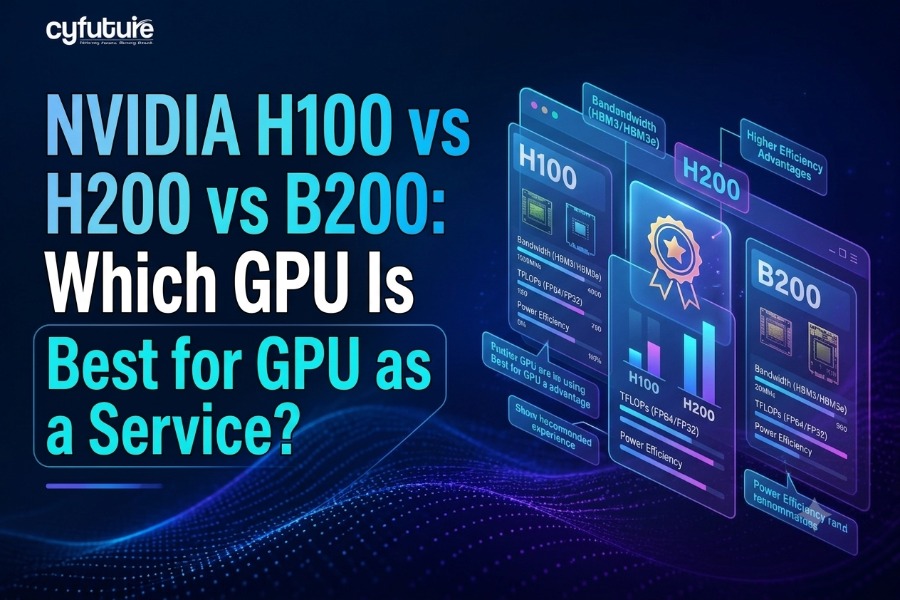
In this comprehensive comparison, we’ll analyze NVIDIA H100 vs H200 vs B200, including architecture, specifications, AI performance, memory bandwidth, ideal use cases, and which GPU delivers the best value for GPU as a Service.
GPU as a Service allows organizations to rent high-performance GPUs from cloud providers instead of purchasing expensive hardware. Businesses can instantly access enterprise-grade AI infrastructure without worrying about:
GPUaaS is widely used for:
Before comparing specifications, it’s important to understand the architectural differences.
Released in 2022, the H100 introduced the Hopper architecture with major improvements in Transformer Engine technology. It significantly accelerated AI training while reducing power consumption.
Key innovations include:
The H200 retains the Hopper architecture but upgrades memory technology.
Major improvements include:
Instead of dramatically increasing compute power, the H200 focuses on reducing memory bottlenecks.
The B200 introduces NVIDIA’s revolutionary Blackwell architecture.
It brings:
The B200 is specifically designed for trillion-parameter AI models.
| Specification | NVIDIA H100 | NVIDIA H200 | NVIDIA B200 |
| Architecture | Hopper | Hopper | Blackwell |
| Manufacturing Process | TSMC 4N | TSMC 4N | TSMC 4NP |
| GPU Memory | 80 GB HBM3 (up to 94 GB on some variants) | 141 GB HBM3e | 192 GB HBM3e |
| Memory Bandwidth | ~3.35 TB/s | ~4.8 TB/s | ~8 TB/s |
| Tensor Cores | 4th Generation | 4th Generation | 5th Generation |
| Transformer Engine | Yes | Yes | Second Generation |
| FP8 Support | Yes | Yes | Enhanced FP8 + FP4 |
| NVLink | Generation 4 | Generation 4 | Generation 5 |
| Target Workloads | AI Training | AI Inference & Training | Massive AI & HPC |
| Best Deployment | Enterprise AI | LLM Inference | Hyperscale AI |
Memory plays a critical role when training modern LLMs.
NVIDIA H100
The H100 provides excellent performance with up to 80 GB (or 94 GB in some NVL variants) of HBM3 memory, making it suitable for:
NVIDIA H200
The H200 dramatically increases memory capacity to 141 GB HBM3e.
Benefits include:
For many enterprise AI workloads, the memory upgrade alone offers a substantial performance boost.
NVIDIA B200
The B200 raises the bar with 192 GB HBM3e memory and approximately 8 TB/s memory bandwidth.
Advantages include:
H100 Performance
The H100 remains one of the world’s fastest AI accelerators.
It excels in:
Its Transformer Engine provides exceptional FP8 performance for generative AI.
H200 Performance
The H200 delivers similar compute performance to the H100 but significantly improves workloads limited by memory bandwidth.
Ideal for:
Large models spend less time waiting for memory, improving overall throughput.
B200 Performance
The Blackwell B200 introduces one of the largest AI performance jumps in NVIDIA’s history.
It provides:
Organizations training frontier AI models gain the greatest benefit from the B200.
Buying enterprise GPUs requires substantial capital investment, often running into tens of thousands of dollars per GPU, excluding servers, networking, cooling, and maintenance.
GPU as a Service offers several advantages:
For startups, researchers, and enterprises with variable workloads, GPUaaS provides a cost-effective path to advanced AI infrastructure.
NVIDIA H100
Best for:
NVIDIA H200
Best for:
NVIDIA B200
Best for:
Modern data centers prioritize performance per watt.
H100
Excellent efficiency for enterprise AI deployments.
H200
Slightly improved efficiency due to optimized memory architecture.
B200
Offers the highest AI performance per watt, making it ideal for hyperscale AI infrastructure despite its higher power envelope.
Choose NVIDIA H100 if:
Choose NVIDIA H200 if:
Choose NVIDIA B200 if:
Instead of investing millions in AI infrastructure, businesses can deploy H100, H200, or B200 GPUs through a GPUaaS provider and benefit from:
This approach enables organizations to focus on AI innovation rather than infrastructure management.
The NVIDIA H100, H200, and B200 are all exceptional AI accelerators, but they serve different needs.
The H100 remains a dependable choice for enterprise AI training and HPC, offering strong performance and a mature software ecosystem. The H200 enhances the Hopper platform with significantly more memory and bandwidth, making it ideal for LLM inference, fine-tuning, and memory-intensive AI workloads. The B200, powered by the Blackwell architecture, represents the next generation of AI computing with higher throughput, FP4 support, and unmatched capabilities for trillion-parameter models and hyperscale AI deployments.
For organizations leveraging GPU as a Service, the best choice depends on workload requirements, scalability goals, and budget. H100 provides excellent value for general AI development, H200 excels in memory-heavy applications, and B200 is the preferred option for cutting-edge AI research and enterprise-scale deployments.
The H100 is based on the Hopper architecture and is optimized for AI training. The H200 uses the same architecture but adds 141 GB HBM3e memory and higher bandwidth for memory-intensive workloads. The B200 introduces the Blackwell architecture with 192 GB HBM3e memory, FP4 support, and significantly higher AI performance.
For enterprise LLM training, the H100 remains an excellent option. For larger models requiring more memory, the H200 performs better. For frontier AI and trillion-parameter models, the B200 delivers the highest performance.
Yes. While both GPUs offer similar compute capabilities, the H200’s increased memory capacity and 4.8 TB/s memory bandwidth improve inference speed for large language models, Retrieval-Augmented Generation (RAG), and long-context AI applications.
GPU as a Service eliminates high upfront hardware costs and provides on-demand access to enterprise GPUs, allowing businesses to scale resources, reduce infrastructure management, and pay only for what they use.
Industries such as AI research, healthcare, financial services, autonomous vehicles, scientific computing, media rendering, and hyperscale cloud providers benefit most from the B200 due to its advanced AI performance and scalability.