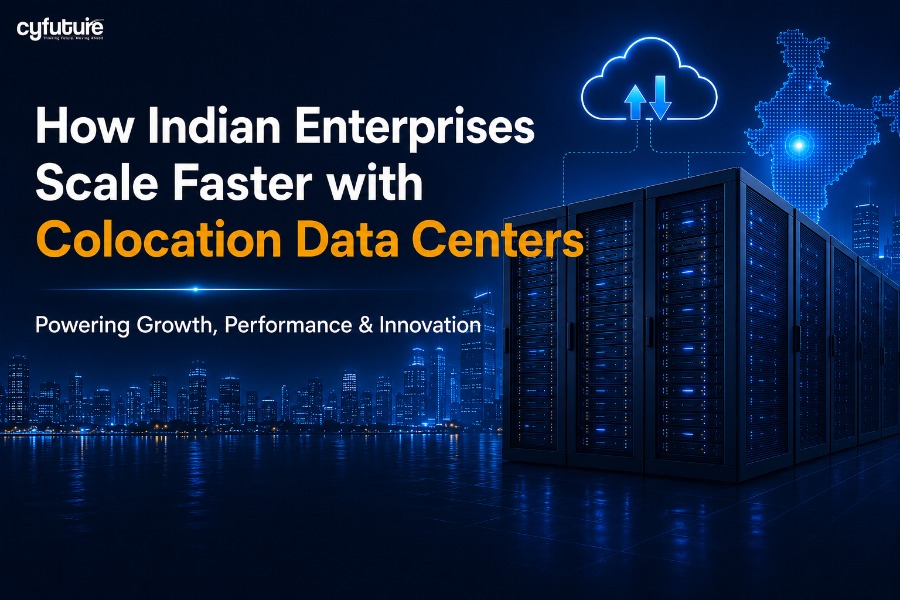
How Indian Enterprises Scale Faster with Colocation Data Centers

Jul 22,2026 by Prachi Priya
10 Views

How Indian Enterprises Scale Faster with Colocation Data Centers

India’s digital economy is growing at an unprecedented pace. Businesses across industries—from banking and healthcare to e-commerce, manufacturing, and artificial intelligence—are expanding rapidly while handling increasing volumes of data. As enterprises adopt cloud computing, AI, IoT, and big data analytics, traditional on-premises IT infrastructure often struggles to meet rising performance, scalability, and security demands.

This is where colocation data centers have become a strategic choice for modern enterprises. Instead of investing heavily in building and maintaining private data centers, organizations are leveraging professional colocation services to house their critical IT infrastructure in highly secure, resilient, and carrier-neutral facilities.

Combined with cloud infrastructure and managed cloud hosting, colocation enables businesses to scale efficiently while reducing operational costs and improving business continuity.

In this article, we’ll explore how Indian enterprises accelerate growth using colocation data centers and why this model is becoming a cornerstone of digital transformation.

What is a Colocation Data Center?

A colocation data center is a facility where businesses place their own servers, networking equipment, and storage systems within a professionally managed environment.

Unlike public cloud services, enterprises retain ownership and control of their hardware while benefiting from enterprise-grade infrastructure, including:

  • Redundant power systems
  • Advanced cooling technologies
  • High-speed internet connectivity
  • Physical security
  • Fire suppression systems
  • 24×7 monitoring
  • Disaster recovery capabilities
See also  Cloud Computing is Fueling Innovations

This approach combines infrastructure ownership with world-class data center operations.

Why Indian Enterprises Are Choosing Colocation

Several market trends are driving colocation adoption in India.

1. Rapid Digital Transformation

Indian organizations are modernizing legacy applications while embracing digital services. As workloads grow, businesses require infrastructure capable of handling increasing traffic without service disruptions.

Colocation facilities provide scalable rack space, allowing enterprises to expand infrastructure whenever required.

2. Rising Cloud Adoption

Most enterprises today operate within a hybrid IT environment.

Applications may run across:

  • Private cloud
  • Public cloud
  • Hybrid cloud
  • Edge infrastructure
  • On-premises systems

A carrier-neutral colocation facility acts as the central hub connecting all cloud environments through low-latency, high-bandwidth connectivity.

This improves application performance while simplifying cloud migration initiatives.

3. AI and High-Performance Computing

Generative AI, machine learning, and GPU computing require enormous processing power.

Modern colocation data centers support:

  • High-density racks
  • GPU servers
  • Liquid cooling
  • AI infrastructure
  • High-speed networking

These capabilities make colocation ideal for AI-driven enterprises.

Key Benefits of Colocation Data Centers

1. Faster Business Scaling

One of the biggest advantages is scalability.

Instead of constructing new server rooms, enterprises simply lease additional rack space.

Benefits include:

  • Rapid infrastructure deployment
  • Flexible expansion
  • Minimal downtime
  • Faster product launches

This agility supports business growth without large capital investments.

2. Lower Infrastructure Costs

Building an enterprise-grade data center requires significant investments in:

  • Land
  • Construction
  • Cooling systems
  • Power infrastructure
  • Fire safety
  • Physical security
  • Skilled personnel

Colocation eliminates these costs.

Businesses only pay for:

  • Rack space
  • Power consumption
  • Connectivity
  • Optional managed services

This converts capital expenditure into predictable operational expenses.

3. Enterprise-Grade Security

Cybersecurity is now a board-level concern.

Professional colocation facilities offer:

  • Multi-factor physical access
  • Biometric authentication
  • CCTV surveillance
  • Security personnel
  • DDoS protection
  • Network segmentation
  • Cloud security integrations

These security measures help organizations protect mission-critical workloads.

4. High Availability

Downtime directly impacts revenue and customer experience.

Tier III and Tier IV data centers deliver:

  • Redundant UPS systems
  • Dual power feeds
  • Backup generators
  • Multiple internet carriers
  • Fault-tolerant infrastructure

This ensures continuous availability for business-critical applications.

5. Better Cloud Connectivity

Cloud adoption continues to accelerate across India.

Colocation facilities offer direct connectivity to leading cloud platforms, enabling enterprises to:

  • Reduce latency
  • Improve workload performance
  • Enhance disaster recovery
  • Optimize cloud costs
  • Build hybrid cloud environments
See also  Is Your SAP HANA Hosting Suitable for Cloud-Native Development?

This seamless integration simplifies enterprise cloud strategies.

Colocation and Cloud: A Powerful Combination

Many organizations mistakenly believe they must choose between cloud computing and colocation.

In reality, the two complement each other.

A hybrid infrastructure allows businesses to:

  • Host sensitive databases on dedicated hardware
  • Run customer-facing applications in the cloud
  • Use cloud storage for backups
  • Deploy AI workloads on GPU clusters
  • Scale applications during peak demand

This approach balances performance, security, compliance, and cost.

Industries Benefiting from Colocation in India

Banking and Financial Services

Banks require:

  • Low latency
  • Regulatory compliance
  • High availability
  • Disaster recovery

Colocation enables secure financial transactions while ensuring uninterrupted operations.

Healthcare

Healthcare providers manage sensitive patient information.

Colocation supports:

  • Electronic health records
  • Medical imaging
  • Telemedicine
  • Secure cloud storage
  • Data compliance

E-Commerce

Online retailers experience seasonal traffic spikes.

Colocation allows businesses to:

  • Scale infrastructure quickly
  • Improve website speed
  • Reduce downtime
  • Support cloud-based applications

Manufacturing

Industry 4.0 technologies generate massive operational data.

Colocation supports:

  • IoT devices
  • Predictive maintenance
  • ERP systems
  • AI analytics
  • Supply chain management

IT and SaaS Companies

Software companies rely on:

  • Continuous uptime
  • Fast deployments
  • Cloud-native infrastructure
  • Secure hosting environments

Colocation provides the stability required for mission-critical applications.

Supporting Digital Transformation

Digital transformation requires more than cloud adoption.

Organizations need:

  • Reliable infrastructure
  • Secure networking
  • Business continuity
  • Cloud integration
  • Disaster recovery
  • High-speed connectivity

Colocation becomes the foundation upon which enterprises modernize operations while maintaining flexibility.

Disaster Recovery and Business Continuity

Unexpected disruptions—from cyberattacks to natural disasters—can severely impact operations.

Colocation facilities provide:

  • Geographic redundancy
  • Backup power
  • Multiple ISPs
  • Automated failover
  • Cloud backup integration
  • Disaster recovery services

These capabilities minimize downtime and ensure business resilience.

Sustainability and Energy Efficiency

Modern colocation providers invest in sustainable infrastructure, including:

  • Energy-efficient cooling systems
  • Renewable energy initiatives
  • Intelligent power management
  • Water-efficient cooling technologies
  • Optimized Power Usage Effectiveness (PUE)

By leveraging shared infrastructure, enterprises reduce their environmental footprint while lowering operational costs.

Choosing the Right Colocation Partner

Selecting the right provider is crucial for long-term success. Consider the following factors:

Infrastructure Quality

Look for Tier III or Tier IV-certified facilities with redundant power, cooling, and network connectivity.

Network Ecosystem

Choose a carrier-neutral data center that offers multiple telecom providers and direct cloud connectivity.

Scalability

Ensure the provider can support future growth with flexible rack space and high-density deployments.

See also  The Benefits of Outsourcing Cloud Management

Security

Evaluate both physical and cybersecurity measures, including biometric access, surveillance, and compliance certifications.

Managed Services

Providers offering remote hands, managed cloud hosting, cloud migration, and infrastructure monitoring can reduce operational complexity.

Compliance

Verify certifications such as ISO 27001, PCI DSS, SOC 2, and other industry-specific standards relevant to your business.

Future of Colocation in India

India’s colocation market is poised for significant growth, driven by:

  • Expansion of AI and GPU-powered workloads
  • Rising enterprise cloud adoption
  • Government initiatives supporting digital infrastructure
  • Increasing demand for edge computing
  • Growth of 5G-enabled applications
  • Data localization requirements
  • Rapid expansion of hyperscale cloud providers

As businesses continue to modernize, colocation will remain a key enabler of scalable, secure, and high-performance IT infrastructure.

Conclusion

For Indian enterprises navigating rapid digital transformation, colocation data centers offer a practical path to scalable and resilient infrastructure. By combining dedicated hardware with enterprise-grade facilities and seamless cloud infrastructure, organizations can reduce costs, improve security, and accelerate innovation.

Whether supporting AI workloads, enabling hybrid cloud solutions, strengthening disaster recovery, or improving application performance, colocation provides the flexibility needed to meet evolving business demands. When paired with managed cloud hosting, cloud migration services, and robust cloud security, it creates a future-ready foundation that empowers enterprises to grow confidently in an increasingly digital economy.

Frequently Asked Questions

1. What is a colocation data center?

A colocation data center is a secure facility where businesses place and manage their own servers while benefiting from enterprise-grade power, cooling, connectivity, and physical security.

2. How does colocation support cloud computing?

Colocation integrates with public, private, and hybrid cloud environments, providing low-latency connectivity, improved performance, and simplified cloud migration.

3. Why are Indian enterprises adopting colocation services?

Enterprises choose colocation to reduce infrastructure costs, improve scalability, enhance security, ensure high availability, and support digital transformation initiatives.

4. Which industries benefit the most from colocation?

Banking, healthcare, e-commerce, manufacturing, IT, SaaS, telecom, media, and AI-driven organizations all benefit from secure and scalable colocation infrastructure.

5. How is colocation different from managed cloud hosting?

With colocation, businesses own and manage their physical servers housed in a third-party facility. Managed cloud hosting provides virtualized infrastructure that is managed by the cloud provider. Many organizations combine both in a hybrid IT strategy for greater flexibility and performance.

0 0 votes
Article Rating
Subscribe
Notify of
guest
0 Comments
Oldest
Newest
Inline Feedbacks
View all comments