 286 Views
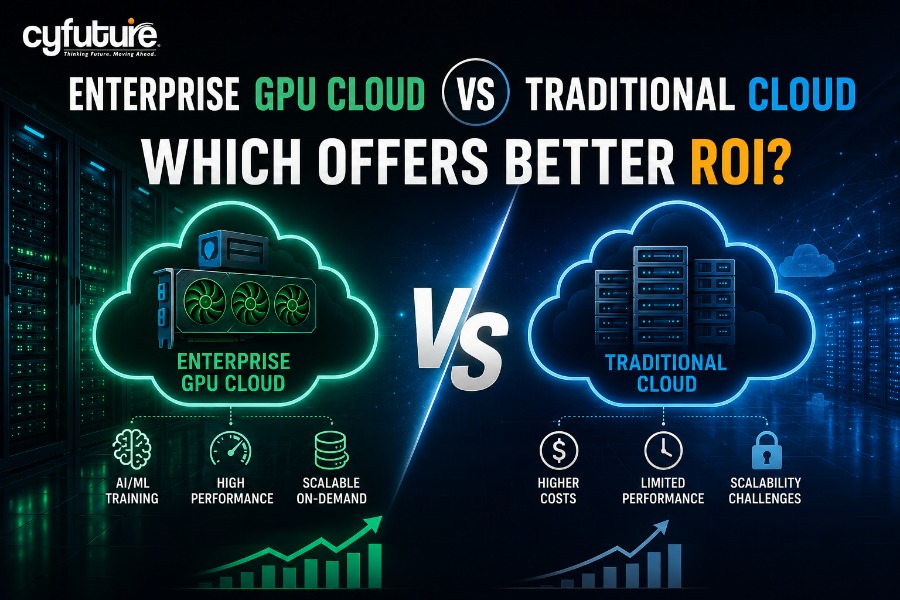
As artificial intelligence (AI), machine learning (ML), generative AI, and high-performance computing (HPC) continue reshaping industries, businesses are rethinking their cloud infrastructure strategies. While traditional cloud infrastructure has powered enterprise applications for years, modern AI workloads require significantly greater computational performance.
This has led to the rapid adoption of Enterprise GPU Cloud, a cloud environment equipped with high-performance Graphics Processing Units (GPUs) specifically designed for AI training, inference, data analytics, scientific computing, and rendering.
But one question remains:
The answer depends on your workloads, business objectives, scalability needs, and long-term infrastructure strategy.
This guide compares both solutions across performance, costs, scalability, energy efficiency, and business value to help enterprises make informed investment decisions.
Traditional cloud platforms primarily rely on CPU-based virtual machines.
They are ideal for:
Traditional cloud environments excel at sequential processing tasks where requests are handled one after another.
For many enterprises, CPU instances remain cost-effective for everyday workloads.
However, AI applications have changed computing requirements dramatically.
Training modern AI models requires billions—or even trillions—of mathematical calculations running simultaneously.
This is where CPUs begin to struggle.
Enterprise GPU Cloud provides cloud infrastructure powered by advanced NVIDIA GPUs such as:
Unlike CPUs, GPUs contain thousands of processing cores capable of executing parallel operations simultaneously.
This makes GPU Cloud ideal for:
GPU Cloud allows organizations to rent high-performance infrastructure without purchasing expensive hardware.
| Feature | Enterprise GPU Cloud | Traditional Cloud |
| Processing Architecture | GPU-Based Parallel Computing | CPU-Based Sequential Computing |
| AI Training | Excellent | Limited |
| Machine Learning | Optimized | Basic |
| Deep Learning | High Performance | Slow |
| Data Analytics | Faster | Moderate |
| Video Rendering | Excellent | Limited |
| Cost for AI Workloads | Lower Long-Term | Higher Due to Longer Processing |
| Scalability | Instant GPU Scaling | CPU Scaling Only |
| Time to Results | Much Faster | Slower |
Performance directly impacts ROI.
The faster your infrastructure processes workloads, the lower your operational costs.
CPU infrastructure performs tasks one at a time or across a limited number of cores.
Complex AI training may take:
This increases infrastructure costs and delays innovation.
GPU Cloud processes thousands of operations simultaneously.
Benefits include:
Shorter processing times directly translate into lower cloud spending.
Many businesses assume GPU Cloud is expensive because GPU hourly pricing is higher than CPU instances.
However, ROI should consider total workload completion cost, not hourly pricing alone.
Example
Traditional Cloud
Enterprise GPU Cloud
Although GPU instances cost more per hour, they finish workloads significantly faster.
Result:
Lower total infrastructure cost.
Developers, data scientists, and AI engineers spend less time waiting for workloads to complete.
Benefits include:
Higher productivity generates significant business value.
Traditional cloud often requires provisioning multiple CPU instances.
GPU Cloud enables enterprises to scale rapidly using:
Organizations pay only for resources they use.
This improves infrastructure efficiency.
Modern AI models require massive computational resources.
Examples include:
Traditional CPU infrastructure cannot efficiently process these workloads.
GPU Cloud dramatically reduces:
GPU Cloud reduces operational complexity.
Managed GPU Cloud providers typically offer:
This minimizes infrastructure management.
Teams focus more on innovation than server administration.
When calculating ROI, organizations should also evaluate:
Building an in-house GPU cluster requires:
These capital expenses can reach hundreds of thousands—or millions—of dollars.
GPU Cloud eliminates upfront investment.
On-premise GPU infrastructure requires:
Cloud providers manage this infrastructure.
High-end GPU servers consume significant power.
Cloud providers optimize:
This reduces operational expenses.
Healthcare
Applications include:
GPU Cloud accelerates research and reduces time-to-market.
Financial Services
Financial institutions use GPU Cloud for:
Real-time analysis improves decision-making.
GPU-powered AI supports:
Faster analytics increase production efficiency.
Retail businesses leverage GPU Cloud for:
Improved customer experiences drive revenue growth.
GPU Cloud accelerates:
Production timelines become significantly shorter.
Traditional cloud remains the better choice for many business applications.
Examples include:
For these workloads, GPU acceleration provides minimal benefit.
GPU Cloud is the superior investment when organizations need:
These workloads benefit substantially from GPU acceleration.
| Business Metric | Traditional Cloud | Enterprise GPU Cloud |
| Innovation Speed | Medium | Very High |
| AI Readiness | Limited | Excellent |
| Scalability | Good | Excellent |
| Infrastructure Efficiency | Moderate | High |
| Time-to-Market | Slower | Faster |
| Competitive Advantage | Moderate | Strong |
| Long-Term ROI | Moderate | High for AI Workloads |
While Enterprise GPU Cloud offers significant advantages, businesses should also consider:
GPU instances are more expensive per hour.
However, faster execution often lowers total project costs.
Teams should understand:
Many managed GPU Cloud providers simplify deployment with ready-to-use environments.
Not every application requires GPUs.
Organizations should align infrastructure with workload requirements to maximize ROI.
The rapid growth of generative AI, foundation models, and real-time analytics has made GPU infrastructure a strategic asset.
Organizations adopting Enterprise GPU Cloud benefit from:
Rather than investing heavily in on-premises hardware, businesses can access cutting-edge GPU resources on demand, enabling them to respond quickly to changing market needs.
Organizations looking to accelerate AI adoption can benefit from managed Enterprise GPU Cloud solutions offered by Cyfuture. With access to enterprise-grade NVIDIA GPU infrastructure, scalable cloud environments, high-speed networking, secure data centers, and expert technical support, businesses can deploy AI workloads without the high capital costs of building their own GPU clusters.
Whether you’re training large language models, running real-time inference, performing data analytics, or supporting HPC workloads, Cyfuture provides flexible GPU resources designed to improve performance while optimizing overall infrastructure costs.
Choosing between Enterprise GPU Cloud and Traditional Cloud ultimately depends on the workloads your business runs.
For general-purpose applications such as web hosting, databases, and business software, traditional cloud remains a practical and economical choice.
However, for AI, machine learning, deep learning, high-performance computing, and advanced analytics, Enterprise GPU Cloud delivers a significantly stronger return on investment. Although GPU instances have a higher hourly rate, their ability to complete workloads much faster often results in lower total project costs, greater developer productivity, faster time-to-market, and a stronger competitive advantage.
As AI adoption continues to grow across industries, Enterprise GPU Cloud is becoming a strategic investment for organizations seeking to innovate faster, scale efficiently, and maximize long-term business value.