 479 Views
The AI boom is fundamentally changing how data centers are designed, built, and operated.
Just a few years ago, most enterprise data centers were optimized for traditional applications, virtualization workloads, and cloud services. Today, the rapid rise of generative AI, large language models (LLMs), computer vision, and AI-driven analytics is creating unprecedented demand for high-performance computing infrastructure.
Modern AI workloads powered by GPUs such as the NVIDIA H100 Tensor Core GPU, NVIDIA H200 Tensor Core GPU, and next-generation NVIDIA GB200 NVL72 generate significantly more heat than traditional servers. As rack densities climb beyond 50kW, 100kW, and even 150kW per rack, conventional air cooling systems are struggling to keep up.
This shift has made liquid cooled AI data centers one of the most important developments in modern AI infrastructure.
Organizations investing in AI factories, GPU clusters, AI cloud platforms, and large-scale model training environments are increasingly turning to liquid cooling technologies to support performance, efficiency, and long-term scalability.
In this guide, we’ll explore what a liquid cooled AI data center is, how it works, why it matters, and how enterprises can prepare for Blackwell and Vera Rubin-era AI infrastructure.
The architecture of AI infrastructure has changed dramatically over the past decade.
Early machine learning environments often relied on CPU-based systems and modest GPU deployments. However, as AI models became larger and more sophisticated, organizations rapidly adopted GPU-accelerated computing.
The progression has been remarkable:
| Generation | Primary Use |
| NVIDIA V100 | Deep learning training |
| NVIDIA A100 | Large-scale AI workloads |
| NVIDIA H100 | Generative AI and LLMs |
| NVIDIA H200 | Memory-intensive AI training |
| NVIDIA Blackwell (GB200) | AI factories and trillion-parameter models |
| Vera Rubin Platform | Next-generation AI supercomputing |
Each generation delivers substantially higher performance, but also consumes more power and produces more heat.
What once required a few GPU servers now demands massive AI clusters with thousands of interconnected GPUs. As a result, rack densities are reaching levels that traditional cooling systems were never designed to support.
This evolution is driving the need for advanced AI infrastructure cooling strategies that can support future-ready AI deployments.
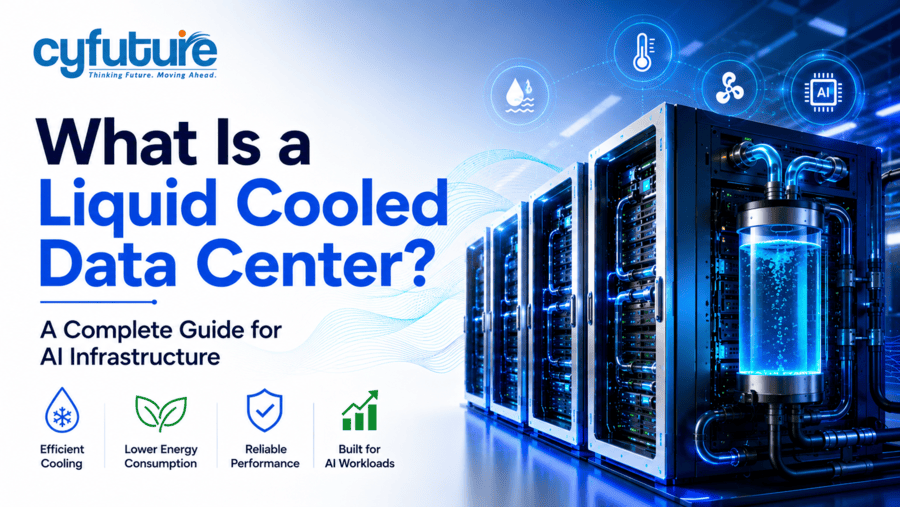
A liquid cooled AI data center is a facility that uses liquid cooling technology instead of relying solely on traditional air conditioning systems to remove heat from AI servers, GPUs, and high-density computing infrastructure.
A liquid cooled AI data center is a data center that uses circulating liquid coolants to absorb and remove heat directly from AI hardware such as GPUs, CPUs, memory modules, and networking equipment. It enables higher rack densities, improved energy efficiency, and better support for AI workloads compared to traditional air-cooled facilities.
Unlike conventional facilities that depend primarily on chilled air, liquid cooling transfers heat through liquids that are significantly more effective at carrying thermal energy.
This makes liquid cooling ideal for:
| Factor | Air-Cooled | Liquid-Cooled |
| Cooling Efficiency | Moderate | Very High |
| Rack Density | Limited | Extremely High |
| Energy Usage | Higher | Lower |
| AI Readiness | Limited | Excellent |
| GPU Performance | Potential Thermal Constraints | Optimized |
| Sustainability | Moderate | Strong |
| Scalability | Limited | High |
| Long-Term Cost Efficiency | Moderate | Better at Scale |
AI servers generate enormous amounts of heat.
Modern GPUs contain billions of transistors operating simultaneously. During AI training, these processors continuously perform intensive mathematical calculations, generating thermal loads that can quickly overwhelm air-cooling systems.
A liquid cooling system works through several key components:
Cold plates or immersion systems absorb heat directly from GPUs and CPUs.
Specialized coolants flow through a closed-loop system carrying heat away from critical components.
Cooling Distribution Units (CDUs) and heat exchangers transfer the collected heat to external cooling infrastructure.
Monitoring systems continuously regulate temperatures, flow rates, and system performance.
Because liquids conduct heat much more efficiently than air, they can remove substantially larger thermal loads while consuming less energy.
Direct liquid cooling has become the preferred approach for many AI-ready data centers.
Cold plates are attached directly to high-heat components such as:
Coolant flows through these plates, absorbing heat and transporting it away from the hardware.
Immersion Cooling
Immersion cooling takes a different approach.
Instead of cooling individual components, entire servers are submerged in a dielectric fluid.
The coolant remains in liquid form while absorbing heat.
The liquid evaporates when heated and condenses back into liquid form.
Rear Door Heat Exchangers
Rear door heat exchangers remove heat at the rack level.
They are installed behind server racks and use liquid-cooled coils to absorb heat before it enters the data hall.
AI workloads are fundamentally different from traditional computing workloads.
Applications driving demand include:
Training advanced AI models can require thousands of GPUs operating continuously.
Challenges include:
Traditional cooling systems often struggle to maintain consistent performance under these conditions.
Liquid cooling enables organizations to sustain high-density AI workloads without compromising performance or efficiency.
The introduction of NVIDIA’s Blackwell architecture represents a major shift in AI infrastructure design.
Systems such as the NVIDIA GB200 and GB200 NVL72 are designed for rack-scale AI computing.
These platforms combine:
As compute density increases, cooling becomes a critical constraint.
Blackwell-based systems are designed to operate at power densities significantly higher than previous generations.
Key factors include:
For many deployments, liquid cooling is no longer an optimization. It is a requirement.
Organizations planning Blackwell-ready data centers must evaluate:
The future of AI infrastructure increasingly depends on effective liquid cooling for Blackwell GPUs.
NVIDIA’s roadmap extends beyond Blackwell toward the Vera Rubin platform.
While detailed specifications continue to evolve, industry expectations point toward:
A Vera Rubin ready data center should include:
Enterprises investing in infrastructure today should avoid designing solely for current-generation hardware.
A future-ready AI data center must accommodate multiple generations of AI accelerators, including Vera Rubin AI infrastructure.
Liquid cooling enables significantly higher rack densities compared to traditional air cooling.
Lower operating temperatures help GPUs sustain peak performance for longer periods.
Liquid cooling reduces dependence on power-hungry cooling systems.
Improved efficiency often translates into lower long-term operating expenses.
Less energy consumption supports sustainability initiatives and ESG goals.
Energy-efficient data centers help reduce overall environmental impact.
Better thermal control minimizes hardware stress.
Organizations can support future AI hardware generations without extensive redesigns.
Challenge: Large-scale model training creates significant thermal loads.
Solution: Direct liquid cooling supports dense GPU clusters.
Business Impact: Faster AI development and infrastructure scalability.
Challenge: Delivering high-performance GPU instances efficiently.
Solution: High-density liquid cooled environments.
Business Impact: Increased capacity and operational efficiency.
Challenge: Real-time analytics and risk modeling.
Solution: GPU-accelerated infrastructure with advanced cooling.
Business Impact: Faster decision-making.
Challenge: Medical imaging and genomics processing.
Solution: High-performance liquid cooled clusters.
Business Impact: Accelerated research outcomes.
Challenge: Massive simulation workloads.
Solution: AI cluster cooling for large-scale compute environments.
Business Impact: Faster model validation.
Challenge: Supercomputing-scale simulations.
Solution: Immersion and direct liquid cooling.
Business Impact: Improved computational efficiency.
NVIDIA has actively promoted liquid cooling for modern AI factories and Blackwell deployments, highlighting the thermal demands of next-generation GPU systems.
Microsoft has invested heavily in AI infrastructure capable of supporting high-density AI workloads across its cloud ecosystem.
Google Cloud continues expanding AI infrastructure optimized for large-scale machine learning and AI applications.
Meta Platforms is building increasingly sophisticated AI infrastructure to support advanced model training and inference workloads.
Equinix has expanded support for liquid cooling solutions within colocation environments.
Digital Realty has introduced infrastructure strategies designed to accommodate high-density AI deployments.
While highly effective, liquid cooling introduces several considerations:
Organizations should evaluate total lifecycle costs rather than focusing solely on deployment expenses.
The transition from H100 and H200 deployments to Blackwell and Vera Rubin systems represents a major infrastructure shift.
Future environments will include:
Cooling strategy is rapidly becoming a board-level infrastructure decision.
The organizations that plan early will be better positioned to support future AI growth.
Every organization has unique requirements.
Consider:
✓ Current rack power density assessment
✓ Future Blackwell deployment plans
✓ Vera Rubin readiness strategy
✓ Cooling efficiency goals
✓ Water availability considerations
✓ Sustainability targets
✓ Infrastructure expansion roadmap
✓ AI cluster scaling requirements
✓ Operational expertise availability
✓ Total cost of ownership analysis
The future of AI infrastructure is increasingly tied to liquid cooling.
Emerging trends include:
Over the next decade, liquid cooling is expected to move from a specialized capability to a standard requirement for high-performance AI environments.

A facility that uses liquid-based cooling systems to remove heat from AI hardware such as GPUs and CPUs.
Modern AI workloads generate far more heat than traditional enterprise applications, making liquid cooling more efficient.
A cooling method that uses cold plates and coolant loops to remove heat directly from hardware components.
A facility designed to support the power, cooling, and density requirements of NVIDIA GB200 systems.
Their compute density and thermal output often exceed practical air-cooling capabilities.
Scalable liquid cooling, high-density power infrastructure, and support for future AI hardware generations.
For many large-scale AI deployments, air cooling alone becomes increasingly impractical.
Yes. Liquid transfers heat more effectively and typically reduces cooling-related energy consumption.
Upfront costs, facility modifications, maintenance, and operational expertise requirements.
For high-density AI environments, liquid cooling is widely viewed as the long-term direction of the industry.
AI is reshaping every aspect of data center design.
As organizations deploy larger AI models, build AI factories, and adopt GPU-intensive infrastructure, traditional cooling methods are approaching their practical limits.
The rise of NVIDIA H100, H200, Blackwell, GB200 NVL72, and future Vera Rubin platforms is accelerating the transition toward liquid cooled AI data centers. These environments provide the thermal efficiency, density, sustainability, and scalability required to power the next generation of AI innovation.
For enterprises planning long-term AI investments, liquid cooling is no longer simply an infrastructure enhancement. It is becoming the foundation of future-ready AI infrastructure.
Whether you’re evaluating high-density GPU clusters, planning a Blackwell-ready deployment, building an AI factory, or preparing for Vera Rubin-era computing, now is the time to assess your cooling strategy.
Explore solutions such as GPU as a Service, AI Infrastructure, AI Data Centers, High Performance Computing environments, and liquid-cooled GPU clusters to ensure your organization is ready for the next wave of AI innovation.