
 10 Views
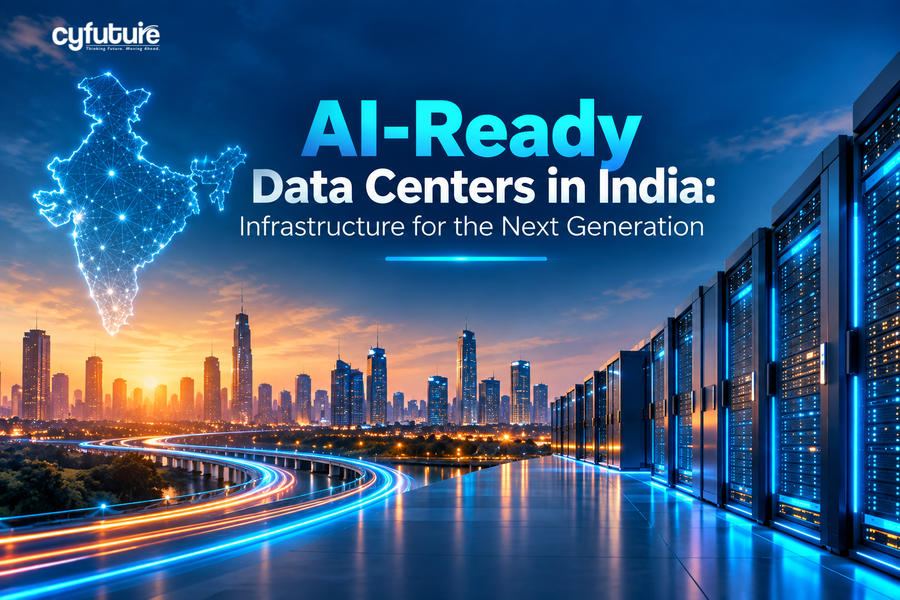
India’s operational data-centre capacity crossed approximately 1,530 MW during the first nine months of 2025, with Mumbai alone accounting for 53% of the national stock, according to CBRE. The market is expanding rapidly, but its next phase will be determined less by headline capacity announcements and more by the availability of power-ready land, resilient connectivity, efficient cooling, and infrastructure capable of supporting AI workloads.
Data centres have become foundational infrastructure for India’s digital economy. They host cloud platforms, enterprise applications, financial systems, streaming services, government digital services, and increasingly, AI and GPU-based computing workloads.
The central thesis is straightforward: India’s data centre market is entering a phase in which capacity expansion, AI-driven compute demand, power availability, and sustainable design will determine which operators and enterprises can scale successfully. Growth will favour providers that can combine colocation capacity, network density, hybrid-cloud capability, and disciplined energy planning.
A data centre is a purpose-built facility that houses servers, storage systems, networking equipment, and supporting electrical and mechanical infrastructure. It provides power, cooling, physical security, monitoring, connectivity, and operational resilience for digital workloads.
Enterprises use data centres to host applications, store data, run analytics, deliver customer-facing digital services, and support private, hybrid, and multi-cloud environments.
| Model | What it means | Typical use case |
| Enterprise data centre | A facility owned and operated by an organisation for its own IT workloads | Banks, manufacturers, large enterprises with predictable or sensitive workloads |
| Data centre colocation | An enterprise rents space, power, cooling, connectivity, and operational support in a shared facility while retaining control of its hardware | Hybrid cloud, compliance-led workloads, network-intensive applications |
| Hyperscale data centre | A very large-scale facility designed for cloud and internet-scale workloads | Public cloud platforms, large SaaS providers, AI training at scale |
| Edge data centre | A smaller facility located closer to users or data sources to reduce latency | 5G, IoT, industrial automation, real-time media, local processing |
| AI data centre | A facility designed for high-density accelerated computing, often using GPUs and specialised cooling | Model training, inference, HPC, simulation, computer vision |
Colocation is particularly important in India because it lets enterprises retain infrastructure control without bearing the full cost and complexity of building a private facility. It also provides access to carrier-neutral connectivity, cloud on-ramps, and interconnection ecosystems.
India’s data centre demand is being driven by a combination of consumer-scale digital adoption, enterprise cloud migration, regulatory requirements, and a new wave of AI infrastructure investment.
Demand is not uniform. A financial-services core-banking workload, a video-streaming platform, a manufacturing IoT deployment, and an AI training cluster have very different requirements for latency, security, storage throughput, network capacity, and cooling.
Estimates differ because analysts measure different things. Some report operational IT capacity, others report colocation revenue, investment commitments, or future power demand. These should not be treated as interchangeable.
The capacity estimates from JLL, CBRE, Cushman & Wakefield, and other research firms differ because of reporting dates, facility definitions, whether standby capacity is included, and whether the measure is IT load, building capacity, or commissioned capacity. Enterprises should therefore use capacity forecasts as directional planning inputs rather than as precise delivery commitments.
India’s data centre capacity remains concentrated in a small number of large metros, where fibre density, enterprise demand, cloud connectivity, and international network access are strongest. Mumbai leads the market, followed by Chennai, Delhi-NCR, and Bengaluru.jll+1
The practical choice is not simply “which city has the most capacity.” It is which location offers the right combination of user proximity, power readiness, fibre diversity, cloud access, disaster-risk profile, and expansion headroom.
Data centre colocation is a model in which an enterprise rents physical space, power, cooling, network connectivity, and facility operations within a shared data centre. The customer retains ownership or control of its servers, storage, networking equipment, and applications, while the colocation provider manages the building infrastructure.
This differs from public cloud, where the cloud provider owns and operates the underlying hardware and abstracts much of the infrastructure from the customer.
| Aspect | Data centre colocation | Public cloud |
| Infrastructure ownership | Customer owns or controls hardware | Provider owns the hardware |
| Workload control | High level of control over hardware, network, and configuration | Provider manages much of the infrastructure |
| Scalability | Requires capacity planning and procurement | Can scale more quickly in many cases |
| Customisation | High, including specialised hardware and network design | Limited by provider architecture and service catalogue |
| Data location | Customer can select a specific facility | Depends on provider regions and services |
| Best suited for | Predictable workloads, compliance needs, hybrid cloud, latency-sensitive systems | Variable workloads, rapid scaling, managed services, elastic applications |
Interconnection matters because application performance often depends on network design as much as compute capacity. A well-connected colocation facility can reduce latency, improve resilience through diverse routes, and make hybrid-cloud architectures more predictable.
AI is changing the economics and engineering of India’s data centre market. Traditional enterprise workloads are often designed around moderate rack densities and air-based cooling. AI workloads are different.
GPU-based accelerated computing supports AI model training, fine-tuning, inference, large language models, generative AI, computer vision, scientific computing, digital twins, and simulation. These workloads require high-bandwidth interconnects, low-latency networking, high-performance storage, and carefully planned power distribution.
| Requirement | Traditional enterprise workload | AI/GPU workload |
| Compute | CPU-led | GPU- and accelerator-led |
| Rack density | Often lower | Materially higher |
| Power per rack | Moderate | High |
| Heat output | Moderate | High and concentrated |
| Networking | Standard enterprise connectivity | High-bandwidth, low-latency GPU interconnects |
| Storage | Mixed workload profiles | High throughput and low latency for training data |
| Cooling | Often air-based | Increasingly liquid, direct-to-chip, or immersion-based |
| Capacity planning | Predictable growth | Step-change demand, specialised procurement |
Rack power density can be expressed as:
Rack power density=Total rack power/Rack volume
As more GPUs are packed into a rack, power density rises. That makes power distribution, heat removal, floor loading, airflow management, and failure-domain design more complex.
India’s policy environment is also responding. The government stated in November 2025 that about 38,231 GPUs had been onboarded through 14 empanelled service providers or data centres under the AI compute capacity framework. This indicates public investment in AI compute access, though it should not be read as a measure of total private-sector GPU capacity or future AI data-centre demand.
Power is the most important constraint for India’s data-centre expansion. A data centre needs not only electricity, but reliable, scalable, and economically viable power at the right location.
Data-centre operators must plan for:
The Ministry of Power estimates that electricity demand from data centres will reach 13.56 GW by 2031–32. This is a power-demand forecast, not an installed data-centre capacity forecast, and it highlights why grid planning and site selection are becoming board-level infrastructure issues.
Data centre cooling removes heat generated by IT equipment. Traditional facilities commonly use chilled water, computer-room air handlers, and air-based heat removal. As rack densities increase, operators are evaluating:
Power usage effectiveness, or PUE, is a widely used facility-efficiency measure:
PUE=Total facility energy/IT equipment energy
A lower PUE generally indicates more efficient facility operations. However, PUE alone does not capture water consumption, carbon emissions, embodied carbon in construction, equipment lifecycle impacts, or workload efficiency.
Water usage effectiveness, or WUE, measures water consumed relative to IT energy use. It is increasingly relevant in India because cooling design must account for local water availability, treatment requirements, and seasonal conditions.
Sustainable data-centre design therefore requires a broader view than renewable-energy procurement alone. It includes energy efficiency, water stewardship, land use, materials, emissions accounting, resilience, and responsible end-of-life management.
Data centres depend on connectivity as much as compute. A facility with strong compute capacity but limited fibre diversity, poor cloud access, or weak interconnection can become an operational constraint.
Important connectivity elements include:
India’s international connectivity position is strengthening as new submarine-cable systems come online. TRAI’s chairman has said that new undersea cables expected to become operational in 2025 could increase India’s data-transmission capacity fourfold. For data-centre planners, the relevant question is not only national capacity, but whether a specific facility has diverse, scalable, and resilient access to those routes.
Data centre investment in India is coming from multiple categories of capital and operating expertise:
Investment covers more than server halls. It includes greenfield development, capacity expansion, land acquisition, substations and power infrastructure, submarine cables, network infrastructure, GPU and AI systems, cooling systems, renewable-energy projects, and edge facilities.
CBRE reported that India’s data-centre investment commitments reached about USD 94 billion, with USD 30 billion pledged during the first nine months of 2025. CEEW similarly cites approximately USD 95 billion in committed investment during 2019–2025 and expects commitments to exceed USD 100 billion by 2027.
These figures represent announced or committed investment, not guaranteed completed capacity. Projects can be delayed by land acquisition, power connection timelines, equipment supply, financing conditions, design changes, and execution capacity.
India’s data centre market has strong demand fundamentals, but delivery is becoming more complex.
These constraints will not prevent growth. They will influence where projects are built, how quickly capacity becomes operational, what it costs, and which facilities can realistically support next-generation workloads.
The 2027 outlook points to continued expansion in hyperscale and colocation capacity, alongside a structural shift toward AI-ready infrastructure.
The market outlook for 2027 and beyond is therefore not simply a story of more megawatts. It is a shift toward power-ready, connected, water-aware, and AI-capable digital infrastructure.
Enterprises should assess a facility against workload requirements, not marketing claims. A facility suitable for standard enterprise compute may not be suitable for high-density AI training or latency-sensitive financial workloads.
| Evaluation area | Questions to ask |
| Location | Is the facility close to users, cloud regions, and network routes? What are the natural-disaster and flood-risk exposures? |
| Power | Does the site have reliable, scalable, and sustainable power availability? What is the committed power capacity and expansion path? |
| Cooling | Can the facility support current and future workload density? Does it support liquid cooling or high-density AI racks? |
| Connectivity | Does it offer carrier diversity, cloud on-ramps, internet exchange access, and low-latency interconnection? |
| Resilience | What are the redundancy, uptime, maintenance, and disaster-recovery arrangements? |
| Security | What physical and cyber-security controls, access governance, and incident-response processes are in place? |
| Scalability | Can the facility support future expansion without disruptive migration? |
| Sustainability | What are the PUE, renewable-energy, water, emissions, and reporting commitments? |
| Operations | What monitoring, support, escalation, and service-level commitments are available? |
| Commercial terms | Are pricing, contract terms, expansion rights, power commitments, and exit provisions clear? |
For AI workloads, enterprises should also ask about GPU availability, interconnect topology, storage performance, cooling compatibility, rack power limits, and the operator’s ability to support future accelerator generations.
Cyfuture’s data-centre and cloud capabilities are designed to help enterprises balance performance, resilience, scalability, and operational control.
Cyfuture can support enterprises through:
Explore Cyfuture’s data centre colocation services, learn how Cyfuture Cloud supports scalable enterprise workloads, and understand GPU infrastructure for AI workloads.
Cloud adoption, digital services, enterprise digital transformation, data localisation requirements, 5G and IoT deployment, and AI adoption are the principal demand drivers. AI is adding a new category of demand through GPU-based training, fine-tuning, and inference workloads.
Colocation lets an enterprise rent space, power, cooling, connectivity, and facility operations in a shared data centre while retaining control of its own servers, storage, and applications. It is commonly used for hybrid cloud, compliance-sensitive workloads, and network-intensive applications.
AI workloads use GPU servers that consume more power per rack, generate more heat, and require high-bandwidth interconnects and high-performance storage. This increases demand for liquid cooling, robust power distribution, and AI-ready facility design.
Mumbai is the largest market, followed by Chennai, Delhi-NCR, and Bengaluru. Hyderabad, Pune, Kolkata, and selected Tier-II and Tier-III markets are also becoming relevant for enterprise, edge, and regional workloads.
Data centres require continuous, scalable electricity for IT equipment, cooling, and resilience systems. Limited substation capacity, delayed grid connections, and constrained renewable-energy procurement can delay projects or restrict expansion.
PUE, or power usage effectiveness, is total facility energy divided by IT equipment energy. A lower value generally indicates more efficient facility operations, but it does not by itself measure water use, carbon emissions, or workload efficiency.
Choose colocation when control, predictable performance, specific hardware, data placement, or hybrid-cloud interconnection is important. Choose public cloud when elasticity, managed services, and rapid scaling are the priority. Many enterprises use both.
Power availability, AI-ready capacity, liquid cooling, water stewardship, renewable-energy procurement, connectivity resilience, and execution capability will shape the market. Investment commitments are high, but delivered capacity will depend on project execution and infrastructure readiness.
India’s data centre market is moving from a capacity-growth story to an infrastructure-execution story. Demand from cloud adoption, digital services, data localisation, and AI is strong, but the operators that succeed will be those able to deliver power-ready, connected, sustainable, and AI-capable capacity at scale.
For enterprises, the decision is no longer only about selecting space in a facility. It is about choosing an infrastructure partner and architecture that can support current workloads, future AI requirements, regulatory obligations, and long-term operational resilience.