 225 Views
Artificial intelligence is changing the way businesses build, store, process, and use data. From generative AI and large language models (LLMs) to computer vision, autonomous systems, predictive analytics, and high-performance computing (HPC), modern workloads require significantly more computing power than conventional enterprise applications.
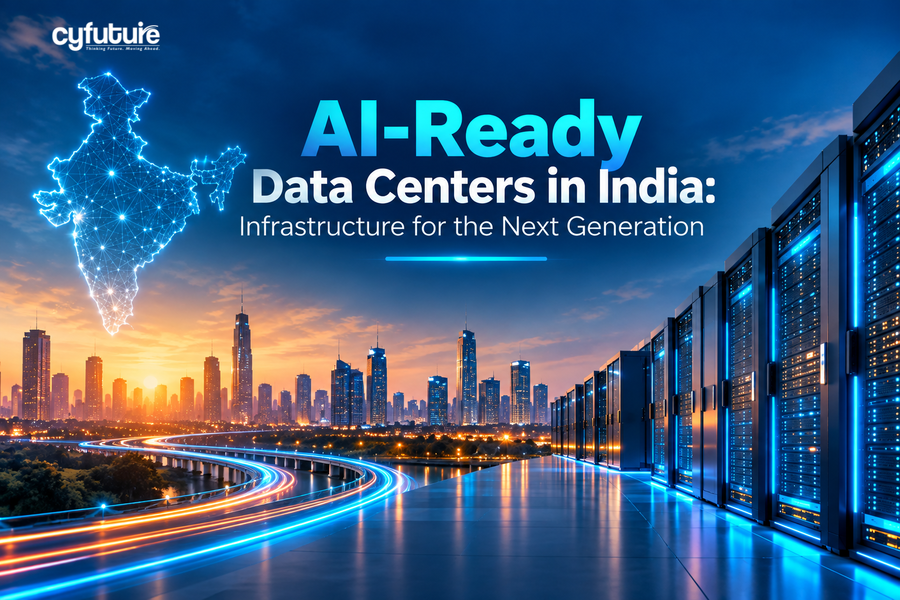
This transformation is creating a new category of infrastructure: AI-ready data centers.
India is particularly well positioned for this shift. The country’s data center capacity has expanded rapidly alongside cloud adoption, digital services, 5G, enterprise modernization, and AI. According to recent government-linked industry data, India’s data center capacity grew from approximately 375 MW in 2020 to around 1,500 MW by 2025. The Economic Survey 2025–26 also reported installed capacity of around 1,280 MW as of June 2025, with industry estimates projecting expansion toward approximately 4 GW by 2030.
However, AI-ready infrastructure is not simply about adding more servers. AI workloads require high-density computing, accelerated networking, advanced cooling, resilient power infrastructure, large-scale storage, and software-defined resource management.
An AI-ready data center is a facility designed to support demanding artificial intelligence, machine learning, deep learning, and high-performance computing workloads.
Traditional data centers were primarily designed around CPU-based workloads and relatively moderate rack densities. AI infrastructure introduces GPUs, accelerators, high-speed interconnects, large memory requirements, and intensive data movement.
An AI-ready facility therefore needs to address several infrastructure layers simultaneously:
India’s national AI strategy has already recognized the importance of specialized compute infrastructure. A MeitY expert-group report proposed a multi-tier AI compute model covering high-end, mid-range, and edge computing, with requirements including thousands of GPUs, high-performance storage, high-speed networks, and scalable infrastructure.
The growth of AI in India is increasing demand for infrastructure capable of handling large volumes of computation and data.
Businesses across banking, healthcare, telecommunications, manufacturing, retail, logistics, media, and government are exploring AI for automation, forecasting, personalization, fraud detection, computer vision, conversational AI, and decision support.
At the same time, Indian startups and research organizations need access to affordable GPU resources to develop and train AI models.
The IndiaAI Mission is addressing this requirement by building an ecosystem around AI compute, datasets, foundation models, future skills, startup financing, and safe and trusted AI. Its compute initiative provides access to GPU-based infrastructure through empanelled service providers.
Recent IndiaAI information also shows that its ecosystem includes cloud-based AI compute, network, storage, and AI platform services. This demonstrates that AI infrastructure is increasingly being treated as a national digital infrastructure priority rather than simply an enterprise IT requirement.
GPUs are at the center of many modern AI workloads.
Training and running large AI models can require hundreds or thousands of accelerators working together. These systems generate substantially more heat and consume more power than conventional enterprise servers.
This makes GPU density an important consideration when designing AI data centers.
AI-ready facilities should provide:
The infrastructure should also be designed so that new GPU generations can be deployed without requiring a complete redesign of the facility.
Cooling is one of the biggest challenges associated with AI data centers.
Traditional air cooling can become less practical as rack power density increases. High-performance GPU systems generate significant heat, making advanced thermal management increasingly important.
Technologies such as direct-to-chip liquid cooling, rear-door heat exchangers, immersion cooling, and advanced air/liquid hybrid systems can help data centers manage high-density workloads.
Recent Indian industry reporting highlights the increasing adoption of direct-to-chip liquid cooling, adiabatic cooling, and immersion cooling as operators respond to AI-related density and efficiency requirements.
For Indian data centers, cooling design also needs to consider local climate conditions and water availability. Efficient cooling can help operators balance performance, energy consumption, operating costs, and sustainability.
AI computing is power-intensive.
A data center can have excellent servers and networking infrastructure, but without reliable electricity, those systems cannot deliver consistent performance.
AI-ready facilities therefore require:
The scale of India’s future power requirement is significant. According to recent government-linked reporting, electricity demand from data centers could reach approximately 13.56 GW by 2031–32.
This makes power availability and grid connectivity important factors when organizations select locations for future AI infrastructure.
AI workloads are not limited by compute alone.
Training large models involves moving massive datasets between storage systems and GPUs. When hundreds or thousands of GPUs operate together, network performance can become a critical bottleneck.
AI-ready data centers therefore require high-bandwidth, low-latency networks capable of supporting distributed computing.
Important components include:
India’s AI infrastructure planning has emphasized secure, distributed data grids and high-speed connectivity as part of future AI compute infrastructure.
AI models depend heavily on data.
Training datasets can contain enormous volumes of text, images, video, audio, sensor information, and enterprise records. Consequently, AI-ready data centers need storage infrastructure that can deliver both capacity and speed.
A modern AI storage architecture may include:
India’s national AI ecosystem is also developing resources around datasets and models. AIKosh, for example, provides access to datasets, models, toolkits, and AI development resources.
AI infrastructure often processes sensitive enterprise, customer, financial, healthcare, or government information.
Security therefore needs to be built into the data center architecture from the beginning.
An AI-ready data center should consider:
For organizations operating in regulated sectors, choosing infrastructure within India can also support data governance and localization requirements where applicable.
Not every AI workload needs to run in a centralized hyperscale facility.
Applications such as smart manufacturing, autonomous systems, telecom networks, video analytics, connected vehicles, and real-time retail systems may require extremely low latency.
This is driving interest in edge data centers.
Instead of sending every piece of data to a distant centralized facility, organizations can process selected workloads closer to where data is generated.
India’s data center expansion is expected to include both large centralized facilities and edge-ready capacity, particularly as 5G and digital applications expand beyond major metropolitan areas.
India’s data center market is entering a significant expansion phase.
Industry estimates cited by IBEF indicate that India’s installed data center capacity could reach around 3 GW by 2030, compared with approximately 1.1 GW in 2024. Another ICRA estimate projected operational capacity of approximately 2,000–2,100 MW by March 2027, supported by large investment pipelines.
Mumbai, Chennai, Hyderabad, Bengaluru, Pune, and Delhi-NCR are among the important markets supporting India’s digital infrastructure growth.
The expansion is being supported by several factors:
This creates a significant opportunity for data center operators, cloud providers, enterprises, and infrastructure partners.
AI-ready infrastructure must not only deliver performance; it must also become more energy efficient.
As data center capacity increases, operators will face growing pressure to reduce power consumption, optimize cooling, minimize water usage, and integrate renewable energy.
Key approaches include:
The goal is to increase computing output without allowing energy and operating costs to grow at the same rate.
The most important characteristic of an AI-ready data center is scalability.
AI hardware evolves quickly. A facility designed only for today’s GPU requirements may become constrained as future accelerators require greater power, cooling, and networking capacity.
Future-ready facilities should therefore use modular designs that allow operators to expand:
This approach allows organizations to respond to changing AI requirements without repeatedly rebuilding their infrastructure.
Organizations building AI infrastructure do not always need to develop and operate an entire data center themselves.
Data center and cloud infrastructure providers can offer access to secure facilities, dedicated servers, GPU infrastructure, colocation, connectivity, power, cooling, and managed infrastructure.
For businesses evaluating an AI infrastructure provider, important considerations include:
IndiaAI’s current compute ecosystem also demonstrates the growing role of private-sector infrastructure providers. Its empanelled provider list includes organizations such as Cyfuture, Sify, NTT, Tata, Yotta, CtrlS, and others.
The future of India’s digital economy will increasingly depend on infrastructure capable of supporting AI at scale.
AI-ready data centers will become more than facilities filled with servers. They will function as integrated computing platforms combining GPUs, high-performance storage, advanced networking, intelligent power systems, liquid cooling, automation, cybersecurity, and sustainable energy strategies.
India has already established a strong foundation for this transformation through expanding data center capacity and initiatives such as the IndiaAI Mission. The next phase will focus on increasing compute availability, improving efficiency, supporting domestic AI development, and making advanced infrastructure accessible to more organizations.
For enterprises, the message is clear: AI strategy and infrastructure strategy can no longer be treated as separate priorities.
Organizations planning AI deployments should evaluate whether their infrastructure can handle increasing GPU density, data volumes, networking requirements, power consumption, and cooling demands.
The companies that invest in flexible and scalable infrastructure today will be better positioned to adopt the next generation of AI technologies tomorrow.
AI-ready data centers in India are becoming a critical foundation for the country’s next phase of digital growth. The combination of GPU computing, high-speed networking, advanced cooling, resilient power, high-performance storage, security, and sustainable design is creating a new generation of data center infrastructure.
With India’s data center capacity expanding rapidly and national initiatives supporting AI compute access, the ecosystem is moving toward a more distributed, scalable, and AI-focused infrastructure model.
For businesses, startups, researchers, and technology providers, the opportunity is significant. The organizations that build or select AI-ready infrastructure with scalability, performance, security, and efficiency in mind will be better equipped to support increasingly sophisticated AI workloads