 399 Views
In today’s digital-first economy, businesses depend heavily on uninterrupted access to applications, customer data, and mission-critical systems. Whether it’s a cyberattack, hardware failure, natural disaster, or unexpected power outage, any disruption can lead to significant financial losses, reputational damage, and operational downtime.
According to industry reports, the average cost of IT downtime continues to rise, making business continuity and disaster recovery (BCDR) essential components of every organization’s IT strategy. Traditional on-premise infrastructure often struggles to provide the resilience required to withstand modern threats.
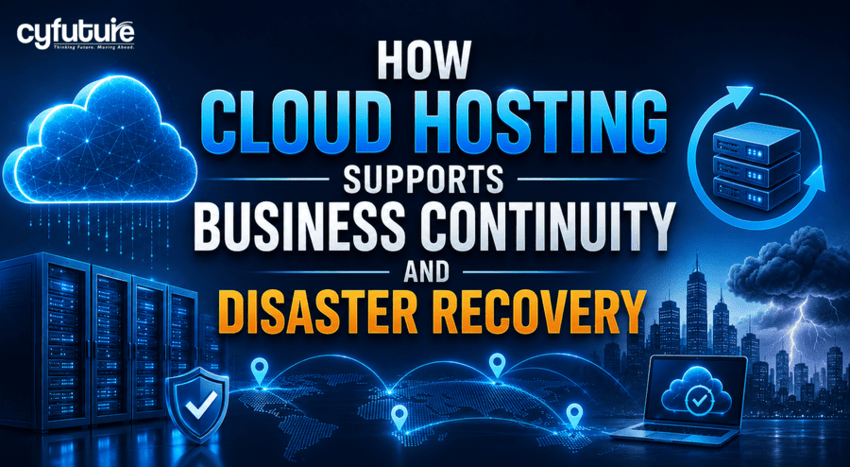
This is where cloud hosting has transformed the landscape. By combining scalable infrastructure, automated backups, geographically distributed data centers, and rapid recovery capabilities, cloud hosting enables businesses to maintain operations even during unexpected disruptions.
At Cyfuture, organizations gain access to enterprise-grade cloud infrastructure designed with built-in redundancy, high availability, and disaster recovery capabilities. This ensures critical applications remain operational while minimizing downtime and data loss.
In this guide, we’ll explore how cloud hosting strengthens business continuity and disaster recovery, its key benefits, and why businesses are increasingly choosing cloud-based resilience solutions.
Although often used interchangeably, business continuity and disaster recovery serve different purposes.
Business continuity focuses on keeping business operations running during and after an unexpected event. It includes:
The objective is simple—ensure business functions continue with minimal interruption.
Disaster recovery is a subset of business continuity that focuses specifically on restoring IT infrastructure, applications, and data after an incident.
A disaster recovery strategy typically includes:
Cloud hosting supports both by providing resilient infrastructure that minimizes downtime and accelerates recovery.
Businesses today face numerous risks that can disrupt operations.
These include:
Without a robust cloud hosting solution, recovering from these incidents can take hours—or even days.
Modern cloud hosting platforms are built with redundant servers, storage systems, and networking components.
If one server fails, workloads automatically shift to another available node without affecting users.
This high availability architecture significantly reduces downtime and ensures business applications remain operational.
Cyfuture delivers enterprise-grade infrastructure with built-in redundancy that supports uninterrupted business operations across diverse workloads.
One of the biggest advantages of cloud hosting is automated backup.
Instead of relying on manual backup schedules, cloud environments can automatically create:
These backups can be restored within minutes, reducing recovery time significantly.
Businesses also avoid the risk of backup failures caused by human error.
Cloud providers replicate data across multiple geographically separated data centers.
If one facility experiences an outage, workloads continue operating from another location.
This ensures:
Cyfuture offers secure data center infrastructure designed to enhance redundancy and business continuity for enterprises with critical workloads.
Traditional disaster recovery often involves rebuilding physical servers, reinstalling applications, and restoring data manually.
Cloud hosting dramatically simplifies this process.
Virtual machines, containers, databases, and applications can be restored much faster using cloud snapshots and automated recovery workflows.
Recovery that once required days can now happen within minutes.
Unexpected events often create sudden spikes in demand.
For example:
Cloud hosting allows businesses to instantly scale computing resources without purchasing additional hardware.
Cyfuture enables organizations to scale compute, storage, and networking resources on demand, ensuring uninterrupted performance during peak demand or crisis situations.
Different organizations adopt different recovery models depending on business requirements.
The simplest disaster recovery model.
Data is periodically backed up to cloud storage and restored when needed.
Suitable for:
Critical infrastructure remains active in the cloud while production workloads continue on-premises.
During a disaster, additional resources are quickly activated.
Benefits include:
A scaled-down production environment continuously runs in the cloud.
It can rapidly scale during emergencies.
Ideal for:
Production workloads operate simultaneously across multiple cloud environments.
If one location fails, traffic automatically shifts to another.
This provides:
Large enterprises increasingly rely on this strategy for mission-critical operations.
Every minute of downtime can impact revenue and customer trust.
Cloud hosting minimizes service interruptions through automated failover and resilient infrastructure.
Recovery Time Objective (RTO) measures how quickly systems can be restored.
Cloud hosting significantly reduces RTO through automation and virtualization.
Recovery Point Objective (RPO) defines acceptable data loss.
Continuous backups and replication enable organizations to achieve minimal RPO.
Traditional disaster recovery requires duplicate hardware, data centers, and maintenance.
Cloud hosting eliminates these capital expenses through a pay-as-you-use model.
Organizations only pay for resources they consume.
Modern cloud environments include:
These security features reduce the likelihood of data loss during cyber incidents.
Cyfuture integrates advanced security measures to help organizations safeguard sensitive business data while supporting compliance requirements.
Cloud-based business continuity is valuable across nearly every industry.
Hospitals require uninterrupted access to patient records and diagnostic systems.
Financial institutions depend on continuous transaction processing and secure data availability.
Online retailers cannot afford website downtime during sales events.
Production systems rely on continuous connectivity to avoid operational delays.
Learning platforms require consistent uptime for students and educators.
Public services must remain available during emergencies and disaster situations.
Selecting the right cloud hosting provider is just as important as implementing a disaster recovery strategy.
Cyfuture offers a comprehensive cloud ecosystem designed to help organizations build resilient, secure, and scalable IT environments.
Key advantages include:
Whether you’re running business-critical applications, AI workloads, enterprise databases, or customer-facing websites, Cyfuture helps reduce operational risks while ensuring maximum uptime.
Its managed cloud solutions also simplify infrastructure management, allowing IT teams to focus on innovation rather than maintenance.

To maximize the benefits of cloud hosting, organizations should follow these best practices:
Emerging technologies are making disaster recovery even more intelligent and efficient.
Key trends include:
As cyber threats become increasingly sophisticated, cloud hosting providers will continue to enhance resilience with automation, analytics, and intelligent recovery capabilities.
Business disruptions are no longer a question of if but when. Organizations that rely solely on traditional infrastructure risk prolonged downtime, costly data loss, and damaged customer trust.
Cloud hosting provides the resilience modern businesses need through high availability, automated backups, geographic redundancy, scalable infrastructure, and rapid disaster recovery. By integrating business continuity planning with cloud technologies, companies can ensure that critical operations remain available even in the face of unexpected events.
Cyfuture empowers businesses with secure, enterprise-grade cloud hosting solutions that support continuous operations, robust disaster recovery, and long-term digital resilience. From managed cloud services to scalable infrastructure and automated backup capabilities, Cyfuture helps organizations stay prepared for today’s challenges while building a future-ready IT environment.
Cloud hosting improves business continuity by providing high availability, automated backups, data replication, and rapid failover capabilities that minimize downtime during unexpected disruptions.
Business continuity focuses on maintaining business operations during disruptions, while disaster recovery focuses on restoring IT systems, applications, and data after an incident.
Cloud disaster recovery offers faster recovery times, lower infrastructure costs, automated backups, scalable resources, and geographically distributed data centers compared to traditional on-premises recovery methods.
Yes. Cloud-based disaster recovery is cost-effective, scalable, and allows small businesses to protect their data and applications without investing in expensive backup infrastructure.
Cyfuture provides enterprise-grade cloud hosting with high availability, managed services, automated backup solutions, disaster recovery support, robust security, and scalable infrastructure to help businesses maintain continuous operations.