 83 Views
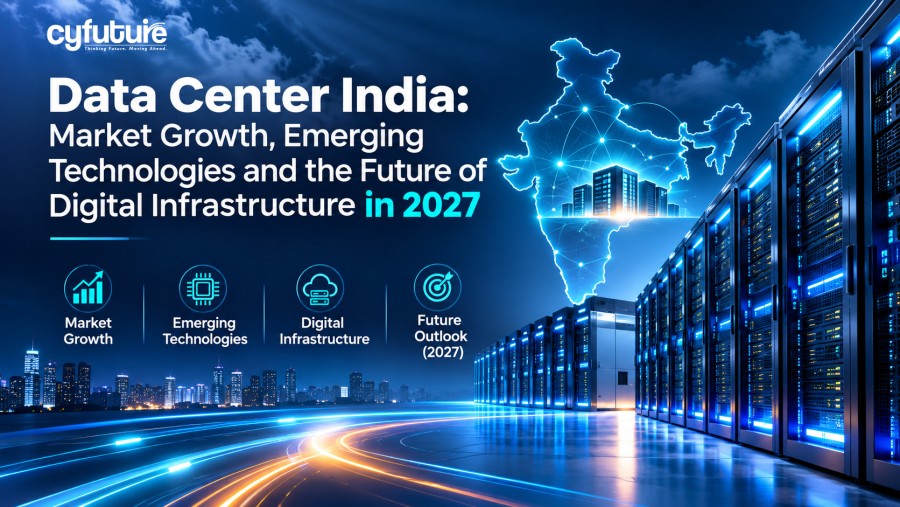
India is rapidly emerging as a strategic destination for global digital infrastructure investment. The growing adoption of artificial intelligence (AI), cloud computing, 5G connectivity, big data analytics and enterprise digitalisation is transforming the country’s data centre landscape.
In 2027, the Data Center India industry is expected to enter another significant growth phase, supported by increasing demand for high-performance computing, hyperscale cloud infrastructure, secure data storage and AI-powered applications.
According to the Ministry of Electronics and Information Technology (MeitY), India’s installed data centre capacity increased from approximately 375 MW in 2020 to around 1,575 MW in 2026. This expansion reflects the country’s growing need for reliable computing and storage infrastructure.
Industry forecasts also indicate substantial future growth. A November 2026 report by CRISIL Ratings projects that India’s installed data centre capacity could reach approximately 7.5 GW by March 2030, supported by investments exceeding ₹3 lakh crore over four financial years.
As businesses increasingly depend on digital platforms, data centres are becoming essential to India’s economic and technological development.
But what will shape the industry in 2027? How will AI, liquid cooling, hyperscale infrastructure and sustainable technologies influence the next generation of data centres?
Let’s explore the major developments, industry trends and real-world use cases defining the future of India’s data centre ecosystem.
India’s data centre market is expanding because organisations need faster, more secure and scalable infrastructure to manage growing volumes of information.
Several interconnected factors are accelerating this growth.
Generative AI, large language models (LLMs), machine learning and deep learning require substantial computing resources. These workloads depend on specialised GPUs, high-speed networking, high-bandwidth memory and advanced cooling infrastructure.
As enterprises adopt AI-powered applications, demand for AI-ready data centres and GPU infrastructure is expected to increase.
Businesses are migrating traditional IT environments to cloud platforms to improve flexibility, scalability and operational efficiency.
Cloud adoption is increasing demand for:
Data centres provide the underlying infrastructure that enables these services.
Digital payments, online shopping, OTT platforms, social media, connected devices and enterprise applications continuously generate data.
Organisations need dependable infrastructure to process, store and retrieve this information without compromising application performance.
Data security, regulatory compliance and control over data processing locations are becoming important considerations for Indian businesses.
The Digital Personal Data Protection Act, 2023, and its associated rules are shaping how organisations approach personal data processing and protection.
As applicable obligations are phased in, businesses are increasingly evaluating secure domestic infrastructure and appropriate data governance arrangements.
Global cloud providers and domestic infrastructure operators are expanding their presence in India.
Large-scale infrastructure investments are expected to increase demand for data centre campuses, electricity, high-speed networks, advanced cooling and specialised IT equipment.
The next generation of data centres will be designed around more than traditional server storage. High-performance computing, intelligent automation and energy-efficient infrastructure will play a major role.
Here are the technologies expected to influence the Indian data centre industry in 2027.
AI-ready data centres are designed to support computationally intensive workloads such as AI training, model fine-tuning, inference and deep learning.
Unlike traditional enterprise facilities, these environments require specialised hardware and infrastructure.
Important components include:
The shift towards AI-ready infrastructure is changing data centre design, rack density requirements and power planning.
Traditional air-cooling systems can face limitations when supporting high-density GPU servers and AI computing clusters.
Liquid cooling is emerging as an important technology for managing the heat generated by modern computing infrastructure.
Major liquid cooling approaches include:
Direct-to-Chip Cooling: Liquid flows through cold plates attached to processors and GPUs to remove heat efficiently.
Immersion Cooling: Servers are submerged in specialised dielectric fluid to manage heat transfer.
Rear-Door Heat Exchangers: Cooling equipment installed at the rear of server racks helps remove heat from exhaust air.
Closed-Loop Cooling: Circulating liquid systems help manage thermal conditions while reducing dependence on conventional cooling approaches.
In 2027, liquid cooling adoption is expected to become increasingly important as operators deploy higher-density AI infrastructure.
Edge computing processes information closer to where it is generated rather than sending every workload to a centralised data centre.
This reduces latency and supports applications that require rapid data processing.
Edge infrastructure is particularly useful for:
India’s growing digital connectivity and 5G adoption are expected to create additional opportunities for edge data centre deployments.
Software-defined data centres use software-based technologies to manage computing, networking and storage resources.
Virtualisation, containerisation, orchestration and infrastructure automation help operators allocate resources more efficiently.
These technologies support:
Artificial intelligence is also transforming the way data centres are operated.
AI-powered monitoring systems can analyse infrastructure performance, detect unusual patterns and help predict equipment failures.
Potential applications include predictive maintenance, cooling optimisation, workload scheduling, energy management and operational anomaly detection.
These capabilities can help operators improve reliability and reduce avoidable operational inefficiencies.
India’s data centre industry is expanding across established metropolitan markets and emerging investment destinations.
Location selection depends on electricity availability, fibre connectivity, submarine cable access, land availability, business demand and state-level policies.
Mumbai remains India’s largest data centre market, supported by financial institutions, cloud providers, telecommunications networks and international connectivity.
Its proximity to submarine cable landing infrastructure makes the region strategically important for hyperscale and enterprise data centre operations.
Chennai is an important data centre destination because of its international connectivity and submarine cable ecosystem.
Its coastal location and expanding digital infrastructure support cloud computing, enterprise hosting and international data traffic.
Noida and the wider Delhi NCR region are growing data centre destinations, supported by enterprise IT demand, government-related digital infrastructure, telecommunications connectivity and cloud adoption.
The region is particularly relevant for organisations seeking colocation, disaster recovery and enterprise infrastructure services.
Bengaluru’s technology ecosystem, software companies, startups and AI innovation activities are contributing to demand for advanced data centre infrastructure.
Hyderabad is attracting large infrastructure investments because of its growing technology ecosystem, development opportunities and expanding hyperscale requirements.
Other locations, including Visakhapatnam, Pune, Kolkata and cities across Andhra Pradesh and Madhya Pradesh, are gaining attention.
The development of new data centre hubs can help distribute infrastructure capacity and support regional digital growth.
Data centres are not limited to hosting websites or storing business files. They support critical digital operations across multiple industries.
Here are seven important real-world use cases.
Banks, insurance companies, payment providers and financial institutions process large volumes of sensitive financial information.
Data centres support:
For example, when customers transfer money through a digital banking application, the underlying systems rely on secure computing, databases and network infrastructure to process transactions.
High availability, data security and reliable infrastructure are essential for these operations.
Hospitals, diagnostic laboratories and healthcare technology providers generate large amounts of medical information.
Data centres support:
For example, a hospital can use centralised infrastructure to store medical images and enable authorised healthcare professionals to access patient records across different locations.
AI applications require specialised computing resources to train models, process information and generate predictions.
Data centres provide GPU infrastructure, high-speed networking and scalable storage for:
For example, an Indian AI startup can use GPU-powered cloud infrastructure to train and deploy machine learning models without investing in its own physical GPU data centre.
Online retailers manage millions of customer interactions, product searches, transactions and inventory updates.
Data centres support:
During major online shopping events, scalable infrastructure helps businesses manage increased website traffic and transaction volumes.
Telecommunications providers need reliable computing infrastructure to support mobile networks, connectivity services and large-scale data processing.
Data centres enable:
They also help support low-latency digital applications and connected devices.
Government departments are increasingly delivering citizen services through digital platforms.
Data centres support:
Reliable domestic infrastructure can support government digitalisation while helping organisations meet applicable security and regulatory requirements.
Manufacturing companies are adopting connected machines, industrial sensors and automation systems to improve operational efficiency.
Data centres help process and store industrial information generated by connected equipment.
Key applications include:
For example, a manufacturing facility can analyse equipment performance data to identify potential failures before they interrupt production.
As India’s data centre capacity expands, energy consumption, water management and environmental sustainability are becoming major infrastructure considerations.
AI workloads and high-density computing systems require substantial electricity and efficient thermal management.
To address these requirements, operators are exploring several sustainable technologies.
Solar and wind energy can help data centre operators diversify electricity sources and reduce carbon emissions associated with conventional power generation.
Renewable energy procurement, power purchase agreements and energy storage systems are important elements of this strategy.
Advanced cooling technologies, including direct-to-chip cooling and liquid cooling, can support high-density computing environments.
The effectiveness of these systems depends on facility design, climate conditions, equipment and operating requirements.
PUE is an important metric for evaluating data centre energy efficiency.
It is calculated as:
PUE = Total Facility Energy / IT Equipment Energy
A PUE value closer to 1.0 indicates that a smaller proportion of total facility energy is being used for non-IT infrastructure.
WUE measures the amount of water used by a data centre relative to its IT energy consumption.
It helps operators evaluate water efficiency and understand the environmental impact of cooling systems.
AI-based energy monitoring can help operators identify inefficient equipment, optimise cooling operations and improve infrastructure utilisation.
Sustainable data centre development will become an increasingly important competitive factor in India’s digital infrastructure market.
Government policies and infrastructure programmes are contributing to India’s data centre expansion.
Some important developments include:
The IndiaAI Mission aims to strengthen India’s artificial intelligence ecosystem through computing infrastructure, datasets, innovation and support for AI startups and research organisations.
Under the AI compute capacity framework, MeitY reported that approximately 38,231 GPUs had been onboarded through empanelled service providers and data centres by March 2026.
This demonstrates the growing importance of accessible GPU infrastructure in India’s AI ecosystem.
Digital India promotes digital infrastructure, online public services and technology adoption.
Its initiatives contribute to demand for secure data processing, connectivity and cloud infrastructure.
The Digital Personal Data Protection framework establishes obligations relating to personal data processing and protection.
The phased implementation of the rules is relevant to data centre operators, cloud providers and enterprises handling personal information.
In October 2026, NITI Aayog introduced its Data Centre Evaluation Framework to help states assess investment readiness, infrastructure requirements, environmental sustainability and economic value.
The framework highlights the importance of electricity, water, land and connectivity when planning future data centre facilities.
Several Indian states have introduced policies and incentives to attract data centre investments.
These policies may address land allocation, electricity, infrastructure development, investment support and project approvals.
Together, these initiatives are strengthening India’s position as a destination for digital infrastructure and AI computing investments.
Selecting a data centre provider is an important decision for organisations managing critical business applications and sensitive information.
Before selecting a facility, businesses should evaluate the following factors.
1. Infrastructure Reliability: Check power redundancy, backup generators, UPS systems and cooling infrastructure.
2. Security: Evaluate physical security, surveillance, access controls and cybersecurity arrangements.
3. Certifications and Compliance: Review relevant certifications, audit reports and applicable regulatory requirements.
4. Network Connectivity: Assess carrier availability, redundant network paths and connectivity options.
5. Scalability: Ensure the facility can accommodate future server, storage and computing requirements.
6. Disaster Recovery: Review backup arrangements, business continuity plans and disaster recovery capabilities.
7. Colocation Flexibility: Evaluate rack space, power allocation, bandwidth and remote-hands support.
8. Cooling Infrastructure: Understand whether the facility can support the thermal requirements of your servers and high-density computing workloads.
9. Service-Level Agreements: Review uptime commitments, incident response processes and support arrangements.
Choosing the right data centre partner can help businesses improve infrastructure reliability, security and long-term scalability.
India’s data centre industry is expected to evolve from conventional infrastructure hosting towards advanced digital computing ecosystems.
Several trends are likely to influence the market beyond 2027.
Future facilities will increasingly be designed around AI workloads, GPU clusters, high-density computing and specialised networking infrastructure.
Large-scale data centre campuses are expected to support the growing requirements of cloud providers, digital enterprises and AI companies.
Organisations will increasingly evaluate infrastructure based on data governance, jurisdiction, security and applicable regulatory obligations.
As GPU density increases, liquid cooling and other advanced thermal management technologies are expected to become more important.
Businesses will increasingly combine centralised cloud infrastructure with edge computing to support real-time applications and geographically distributed operations.
Renewable energy, energy storage, water efficiency and intelligent facility management will play an increasingly important role in future data centre planning.
AI-driven monitoring and automation will help operators improve maintenance planning, resource utilisation and operational visibility.
The next stage of India’s data centre growth will depend not only on adding capacity but also on building infrastructure that is energy-efficient, AI-ready, secure and scalable.
As India’s digital infrastructure requirements continue to evolve, businesses need reliable partners that understand enterprise computing, connectivity, security and infrastructure scalability.
Cyfuture provides data centre and colocation infrastructure solutions designed to support the changing requirements of businesses.
Its infrastructure portfolio and services address requirements such as:
Cyfuture’s MeitY-empanelled, Tier 3-certified data centre facilities in Noida and Jaipur support colocation requirements, while its expanding infrastructure roadmap reflects the growing demand for digital infrastructure across India.
Businesses looking for data centre infrastructure can evaluate solutions based on their computing requirements, security needs, connectivity, power capacity and future expansion plans.
Looking for reliable data centre infrastructure in India? Connect with Cyfuture to explore data centre, colocation and cloud infrastructure solutions for your business.
The future of Data Center India is closely connected to the country’s digital transformation, artificial intelligence adoption and expanding cloud computing ecosystem.
In 2027, emerging technologies such as AI-ready infrastructure, GPU computing, liquid cooling, edge computing and intelligent automation are expected to reshape the way data centres are designed and operated.
At the same time, sustainability, power availability, data governance and infrastructure reliability will remain critical considerations for operators and businesses.
As India continues to strengthen its digital infrastructure ecosystem, data centres will play an essential role in supporting financial services, healthcare, manufacturing, telecommunications, government platforms and AI innovation.
Businesses that invest in reliable, secure and scalable infrastructure will be better positioned to meet future digital requirements.
Cyfuture is committed to supporting India’s growing digital infrastructure ecosystem through data centre, colocation and cloud infrastructure solutions. Explore how the right infrastructure can help your business prepare for the next phase of digital transformation.
India’s data centre industry is expected to grow through increasing AI adoption, cloud computing, enterprise digitalisation and hyperscale investments. AI-ready infrastructure, GPU computing, liquid cooling and renewable energy are expected to be important areas of development.
India’s installed data centre capacity was approximately 1,575 MW in August 2026, according to the Ministry of Electronics and Information Technology. CRISIL Ratings projects that capacity could reach approximately 7.5 GW by March 2030. Forecasts vary depending on the methodology and capacity definitions used.
Major data centre hubs include Mumbai, Navi Mumbai, Chennai, Hyderabad, Bengaluru and Delhi NCR. Emerging destinations such as Visakhapatnam and other locations are also attracting infrastructure investments.
AI is increasing demand for GPU-powered servers, high-density racks, high-speed networking, advanced storage and liquid cooling systems. Data centres are increasingly being designed to support AI training, fine-tuning and inference workloads.
Modern data centres use GPU computing, virtualisation, software-defined infrastructure, liquid cooling, AI-powered monitoring, high-speed networking, advanced security systems and energy-efficient power management.
Data centres support banking and financial services, healthcare, artificial intelligence, e-commerce, telecommunications, government digital services and industrial IoT. They provide the computing, storage and networking infrastructure required to run these applications.
Businesses should evaluate infrastructure reliability, security, connectivity, power redundancy, cooling systems, certifications, scalability, disaster recovery and service-level agreements. Choosing a provider with infrastructure suited to current and future workloads is essential.