 7 Views
Artificial intelligence is transforming how businesses develop products, automate operations and deliver digital services. From generative AI and large language models (LLMs) to computer vision and predictive analytics, modern AI applications require significant computing power, high-speed networking and scalable infrastructure.
Traditional cloud computing provides businesses with flexible computing resources, storage and networking. However, advanced AI workloads often require specialised infrastructure equipped with powerful graphics processing units (GPUs), high-bandwidth interconnects and optimised software environments.
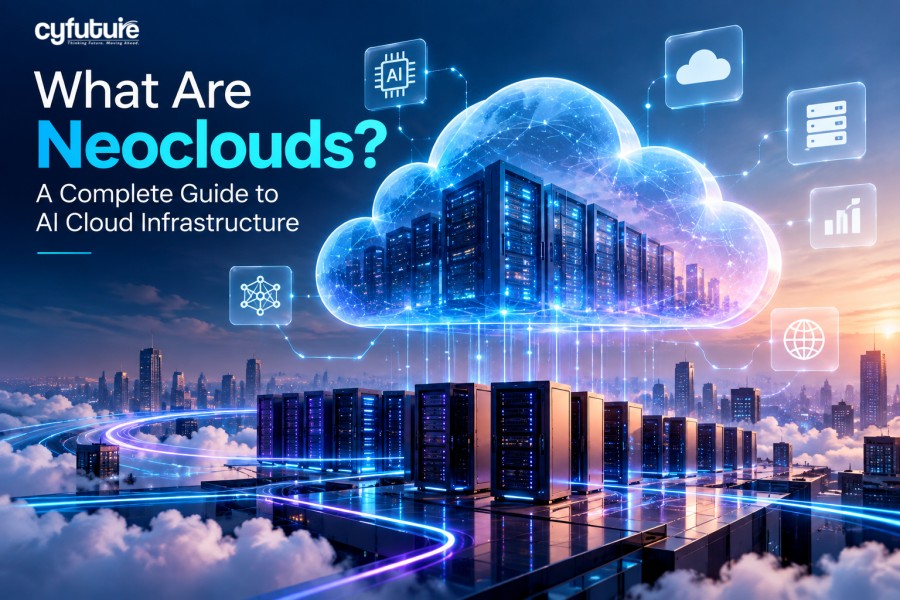
This demand has contributed to the rise of neoclouds, a new category of AI-focused cloud infrastructure providers designed primarily for GPU-intensive workloads.
Neoclouds help organisations access computing resources for AI model training, fine-tuning, inference and high-performance computing without necessarily investing in their own GPU data centres. They can also offer dedicated infrastructure and specialised tools for teams that need greater control over AI workloads.
In this guide, we explore what neoclouds are, how they work, their key benefits, real-world use cases, differences from traditional cloud providers and the factors businesses should consider when choosing a neocloud provider.
Neoclouds are specialised cloud computing platforms designed primarily to support artificial intelligence, machine learning and other computationally intensive workloads. They typically focus on providing high-performance GPU infrastructure, scalable computing capacity, fast networking and AI-oriented software environments.
Unlike traditional cloud providers that serve a broad range of business requirements, neocloud providers concentrate on delivering the infrastructure needed to train, fine-tune and run AI models efficiently.
Their services may include GPU cloud servers, multi-GPU clusters, high-performance storage, containerised environments, orchestration tools and AI inference infrastructure.
For example, a company developing a large language model may need multiple GPUs working together to process massive datasets and perform complex mathematical operations. Instead of purchasing and maintaining an expensive GPU cluster, the company can rent computing resources from a neocloud provider for the duration of its project.
This approach allows AI teams to scale infrastructure according to workload requirements while reducing the need to manage physical hardware.
It is important to note that neocloud is an industry term rather than a formal cloud service category. Providers grouped under this label can differ considerably in their hardware, software, pricing, security and managed services.
The growing adoption of generative AI has changed the computing requirements of modern businesses. Traditional enterprise applications often rely heavily on central processing units (CPUs), while many advanced AI workloads benefit from parallel processing using GPUs and other accelerators.
Several factors are driving the adoption of neocloud infrastructure.
AI models perform millions or billions of mathematical operations during training and inference. GPUs are designed to execute many of these operations in parallel, making them valuable for deep learning, generative AI and scientific computing.
Neocloud providers specialise in making GPU resources available through flexible cloud-based services.
Large language models, multimodal AI systems and advanced neural networks can require substantial computing resources. Training and fine-tuning these models may involve multiple GPUs connected through high-speed networking.
Neocloud infrastructure can help businesses access this specialised computing capacity without building an entire AI data centre.
AI teams need to experiment with models, test configurations and deploy applications quickly. Provisioning suitable GPU hardware internally can involve procurement delays, installation work and infrastructure management.
Cloud-based GPU infrastructure can simplify access to the resources needed for development and experimentation, depending on hardware availability.
Purchasing GPUs, maintaining servers and providing sufficient power and cooling can require significant capital investment.
Neoclouds offer consumption models that may include on-demand instances, reserved capacity and dedicated GPU clusters. These options allow organisations to align infrastructure spending more closely with project requirements.
Actual savings depend on utilisation, data transfer, storage, software licensing and contract terms.
Businesses are increasingly exploring AI chatbots, intelligent search, document processing, recommendation engines and automated workflows.
Neocloud infrastructure can provide the accelerated computing resources needed to develop and operate these applications at scale.
Neocloud infrastructure combines specialised hardware, networking, storage and software to support demanding AI workloads.
A typical environment contains the following components.
GPUs provide the parallel processing capability required by many AI training and inference workloads. Depending on the provider, customers may access NVIDIA GPUs such as A100, H100, B300, or newer accelerator generations, along with other supported hardware.
The appropriate GPU depends on memory requirements, model size, precision, performance targets and workload characteristics.
Large AI workloads frequently distribute computations across multiple GPUs or servers. Fast networking helps these systems exchange model parameters, gradients and other data efficiently.
Technologies such as InfiniBand and RoCE-based Ethernet may be used in high-performance environments. Their suitability depends on the architecture and workload.
AI applications need to access training datasets, model checkpoints, embeddings and inference data.
Neocloud environments may use high-throughput storage, object storage and shared file systems to support data-intensive operations. Storage performance can directly affect how efficiently GPUs remain occupied with useful work.
Software platforms manage GPU allocation, workloads, containers and cluster operations. Technologies such as Kubernetes and specialised job schedulers can help teams deploy applications and distribute computing tasks.
Some providers offer managed orchestration, while others give customers more direct access to the underlying infrastructure.
Neocloud platforms may support machine learning frameworks such as PyTorch and TensorFlow, container images, model-serving tools and AI development environments.
More advanced offerings may include managed training, fine-tuning, inference endpoints and model deployment capabilities.
Enterprise-grade deployments require identity and access management, network controls, encryption, logging, monitoring and appropriate isolation between workloads.
The precise security features vary by provider, so businesses should verify them before moving sensitive workloads.
Neoclouds can offer several advantages for organisations with demanding AI computing requirements.
Businesses can access GPU infrastructure without purchasing every server themselves. This can be especially valuable for startups and research teams that need powerful hardware for limited periods.
Teams can increase or decrease GPU capacity as workloads change, subject to available capacity and contract conditions. This supports experimentation, model development and production deployments.
Specialised infrastructure and focused service offerings may provide attractive economics for GPU-intensive workloads. However, businesses should compare the total cost of ownership rather than assuming every neocloud is cheaper than every hyperscaler.
Multi-GPU and multi-node environments can accelerate certain training tasks when the model, software and networking are configured appropriately.
Depending on the provider, customers may choose shared instances, dedicated servers, reserved GPU capacity or managed AI platforms.
Using a cloud provider can reduce the need for customers to procure, install and maintain physical GPU servers. The amount of operational responsibility transferred depends on the service model.
Traditional cloud platforms support a wide range of workloads, including websites, databases, enterprise applications, analytics and AI. Neoclouds concentrate more heavily on accelerated computing and AI infrastructure.
| Comparison factor | Neoclouds | Traditional cloud providers |
|---|---|---|
| Primary focus | AI and GPU-intensive workloads | Broad computing and enterprise services |
| Hardware emphasis | GPU clusters and accelerators | CPUs, GPUs and other computing resources |
| AI infrastructure | Often specialised for AI performance | Available alongside many other services |
| Networking | May prioritise high-performance cluster networking | Options vary across products and configurations |
| Managed services | Depends on the provider | Often offers a broad managed-service portfolio |
| Flexibility | Focused on AI-specific requirements | Broad range of application and infrastructure needs |
| Best suited for | GPU-intensive AI, training and inference | General IT, enterprise systems and diverse cloud workloads |
Neither model is universally better. Neoclouds can be a strong fit for specialised AI computing, while traditional cloud platforms may be preferable when businesses need extensive managed databases, identity services, enterprise integrations or a broad global application platform.
Many organisations use both approaches as part of a hybrid cloud strategy.
Neocloud infrastructure supports a growing range of practical applications. The most suitable configuration depends on the model, data volume, latency requirements and expected workload.
Training a large language model involves processing substantial datasets and repeatedly updating model parameters. Large-scale projects may require many GPUs connected through high-speed networking.
Neoclouds can provide the GPU clusters and computing capacity needed for these workloads.
An AI research company trains a domain-specific language model on technical documents, industry publications and licensed datasets. It rents a multi-GPU cluster during the training phase instead of building a permanent GPU data centre.
Access to specialised computing resources and the ability to scale training capacity according to project needs.
Fine-tuning adapts an existing model to a particular task, domain or business requirement. Techniques such as parameter-efficient fine-tuning can reduce the resources needed for certain projects.
Neocloud infrastructure can help developers fine-tune language models, vision models and other machine learning systems using custom datasets.
A financial services company adapts an existing language model to classify customer enquiries and summarise approved internal documentation.
Business value: More specialised AI outputs without necessarily training a foundation model from scratch.
Inference is the process of using a trained model to generate predictions or responses. It powers applications such as AI chatbots, content generation tools, recommendation engines and intelligent assistants.
Neocloud providers can supply GPU resources for deploying inference workloads. Some also offer managed endpoints and scaling capabilities.
A software company deploys an AI assistant that answers questions about product documentation and helps customers troubleshoot common problems.
Access to accelerated computing for serving AI requests. Performance and cost depend on model size, request volume, batching, latency targets and GPU utilisation.
Generative AI creates new text, images, audio, video and other forms of content. These applications can require substantial computing resources during both model development and production use.
Neocloud infrastructure can support the development and operation of generative AI tools.
A creative technology company develops an image-generation platform for advertising teams and uses GPU servers to process image-generation requests.
Scalable computing for content-generation workflows without requiring the business to own all the underlying hardware.
Retrieval-augmented generation combines information retrieval with a generative AI model. Rather than relying solely on the model’s internal knowledge, a RAG application retrieves relevant information from an approved knowledge source before generating a response.
A typical RAG architecture includes document ingestion, text chunking, embedding generation, a vector database, a retrieval layer and a language model.
Neocloud GPU resources can support embedding generation, model inference and other compute-intensive parts of this pipeline. The vector database and application services may run on separate infrastructure.
An enterprise builds an internal knowledge assistant that searches product manuals, policy documents and technical support records before generating answers for employees.
More context-aware responses grounded in relevant business documents, subject to retrieval quality and appropriate access controls.
Computer vision systems analyse images and video to detect objects, classify scenes, identify defects or extract visual information.
GPU-accelerated infrastructure can support the training and inference of computer vision models.
A manufacturing business develops an automated quality-inspection system that analyses product images to identify visible defects on a production line.
Faster processing of visual data and the potential to automate repetitive inspection tasks.
Researchers use AI to analyse medical images, process scientific data and investigate complex biological patterns. These workloads may require GPU acceleration and substantial computing capacity.
A medical research team uses a GPU cluster to experiment with image-analysis models on properly authorised and de-identified research data.
Additional computing capacity for research and model development. Clinical deployment requires separate validation, privacy protections and appropriate regulatory oversight.
Financial organisations can use machine learning for fraud detection, anomaly detection, document analysis and forecasting.
Neocloud infrastructure can support training and running compute-intensive models where GPU acceleration is appropriate.
A financial technology company evaluates transaction patterns using machine learning models to flag potentially suspicious activity for further investigation.
Scalable infrastructure for analytical workloads, with outcomes dependent on model quality, data quality and operational controls.
Robotics and autonomous systems use AI to interpret sensor data, understand their environment and make decisions. Training and simulation can require considerable computing resources.
A robotics company uses GPU infrastructure to train perception models and run simulations before testing its systems in physical environments.
Computing capacity for model experimentation and simulation-intensive development.
Researchers and engineers use accelerated computing for molecular modelling, computational fluid dynamics, physics simulations and other high-performance computing tasks.
Some of these workloads benefit from the same GPU infrastructure used for AI.
An engineering team runs GPU-accelerated simulations to investigate material behaviour and compare design alternatives.
Access to specialised compute capacity for research and engineering without maintaining a dedicated cluster for every project.
Recommendation systems help digital platforms suggest products, content and services based on user behaviour and other signals. Some model-training and inference pipelines benefit from GPU acceleration.
An online marketplace develops recommendation models to rank relevant products based on browsing patterns, product attributes and purchase history.
Infrastructure for experimentation and personalised customer experiences, subject to data protection and responsible use requirements.
GPU computing is useful for video analytics, rendering, visual effects and certain AI-powered media workflows.
A media studio rents GPU resources to render complex scenes and process AI-assisted video enhancement tasks during a production deadline.
Business value: Flexible access to accelerated resources during periods of high demand.
Selecting a neocloud provider requires more than comparing advertised GPU prices. Businesses should evaluate technical performance, reliability, security and the overall cost of running their workloads.
Check the exact GPU model, memory capacity, interconnect configuration, number of GPUs per server and availability of multi-node clusters.
Confirm that the hardware supports your model size and software requirements.
Ask about network bandwidth, latency, GPU-to-GPU communication, storage throughput and benchmark results for workloads similar to yours.
The number of GPUs alone does not guarantee proportionate performance improvements.
Compare on-demand rates, reserved capacity, minimum commitments, storage charges, data transfer fees and any setup costs.
Estimate the cost of completing a task, not just the price of one GPU-hour.
Review service-level agreements, maintenance procedures, incident response, support availability and recovery arrangements.
For production AI services, reliability can be as important as raw computing performance.
Evaluate access controls, encryption, network isolation, audit logs, data retention and applicable compliance requirements.
Organisations processing regulated or sensitive information should confirm that the provider’s actual controls meet their obligations.
Check support for your machine learning frameworks, containers, model-serving software and orchestration tools.
Compatibility can reduce migration effort and simplify deployment.
Consider where data is stored and processed, how it can be exported and what it would take to migrate workloads to another provider.
Portable deployment configurations and documented data-export procedures can reduce vendor lock-in.
Although neoclouds can offer compelling advantages, they also present challenges.
Limited service breadth: Some providers do not offer the extensive managed databases, identity tools and enterprise application services available from large cloud platforms.
GPU availability: High-demand hardware may not always be available in the required region or configuration.
Infrastructure dependence: Performance can depend on networking, storage, software configuration and workload optimisation as well as GPU specifications.
Migration complexity: Moving large datasets, model checkpoints and distributed training pipelines between providers may take time and incur transfer costs.
Operational and financial risk: Providers vary in financial stability, infrastructure ownership, capacity commitments and service maturity. Businesses should review contract terms, support arrangements and exit options.
Power and cooling requirements: GPU-intensive data centres consume substantial power and require suitable thermal management. Capacity expansion can therefore depend on physical infrastructure constraints.
A careful evaluation of these limitations helps businesses select infrastructure that matches their technical and commercial requirements.
The future of neoclouds will be shaped by continued AI adoption, demand for GPU capacity, improvements in inference efficiency and the economics of building and operating data centres.
Several developments are likely to influence the sector.
As AI applications move from experimentation into production, providers will need to support consistent inference performance, variable request volumes and efficient resource utilisation.
Advances in accelerators, high-speed networking, memory technologies and cooling systems will continue to influence the design of AI data centres.
Some providers may expand beyond raw GPU rental to offer managed training, model serving, fine-tuning and inference platforms that simplify AI development.
Businesses may combine neocloud GPU capacity with traditional cloud services, private infrastructure and regional data centres to balance performance, cost, security and data residency requirements.
Power consumption, hardware utilisation, inference optimisation and overall cost per AI task are likely to become increasingly important measures of infrastructure performance.
However, market growth does not guarantee that every neocloud provider will succeed. Sustainable operations depend on utilisation, financing, customer demand, pricing discipline and the ability to deliver reliable services.
Businesses exploring AI-first infrastructure can evaluate specialised GPU cloud and AI infrastructure services alongside their existing cloud environments.
Cyfuture can position relevant offerings around the practical requirements of AI developers and enterprises, including GPU computing, AI model development, fine-tuning, inference and deployment.
Depending on the available service configuration, these capabilities can support workloads such as large language model experimentation, generative AI applications, RAG-based knowledge assistants and GPU-intensive computing.
When evaluating Cyfuture or any other provider, businesses should confirm the specific GPU models, availability, networking, pricing, security controls and service commitments required for their workloads.
The objective is to select infrastructure that helps teams develop, deploy and scale AI applications with a suitable balance of performance, cost and operational simplicity.
Neoclouds represent an important development in AI cloud infrastructure. By focusing on GPU-accelerated computing, high-performance networking and AI-oriented workloads, they provide an alternative to building dedicated AI infrastructure or relying exclusively on general-purpose cloud services.
Their potential applications span LLM training, fine-tuning, inference, generative AI, computer vision, scientific computing and enterprise knowledge assistants.
However, choosing the right provider requires a detailed assessment of hardware, performance, pricing, security, availability and long-term reliability.
For businesses planning to adopt AI at scale, the most effective approach is to match infrastructure to the workload, benchmark performance against real requirements and consider hybrid deployment options where appropriate.
As AI applications continue to evolve, neoclouds are likely to remain an important part of the broader infrastructure ecosystem supporting the next generation of intelligent applications.
A neocloud is a specialised cloud platform that primarily provides computing infrastructure for AI and machine learning. It commonly offers GPU servers, accelerated computing clusters and related tools for training and running AI models.
Neoclouds focus on GPU-intensive workloads and AI infrastructure, while traditional cloud providers offer a broader range of services, including databases, virtual machines, storage, analytics and enterprise application tools.
Common use cases include LLM training, AI fine-tuning, inference, generative AI, RAG applications, computer vision, scientific computing, video processing and robotics research.
Yes. They can help startups access specialised GPU infrastructure without purchasing their own hardware. Startups should compare availability, billing models, software compatibility and support before selecting a provider.
Many neocloud providers offer NVIDIA GPUs, although supported models and configurations vary. Businesses should verify the exact hardware and availability with the provider.
Not always. Neoclouds may offer attractive pricing for certain GPU-intensive workloads, but total costs depend on utilisation, storage, networking, data transfer, managed services and contract terms.
Yes. GPU-based neocloud infrastructure can run trained models and serve predictions or generated responses. Some providers also offer managed inference endpoints and scaling tools.
Businesses should evaluate GPU specifications, cluster networking, performance, pricing, availability, security, compliance, technical support, data portability and service-level agreements.
They can be suitable for enterprise AI workloads when the provider meets the organisation’s performance, security, reliability, data governance and compliance requirements.
GPU as a Service (GPUaaS) is a service model that provides access to GPU computing on demand or through committed capacity. Neoclouds are a broader provider category often built around delivering GPUaaS and related AI infrastructure services.