 219 Views
The rapid growth of Artificial Intelligence (AI), Machine Learning (ML), Big Data analytics, scientific computing, and high-performance applications has transformed the way businesses consume computing resources. Traditional CPU-based infrastructure, while effective for general-purpose computing, often struggles to meet the massive processing demands of modern workloads.
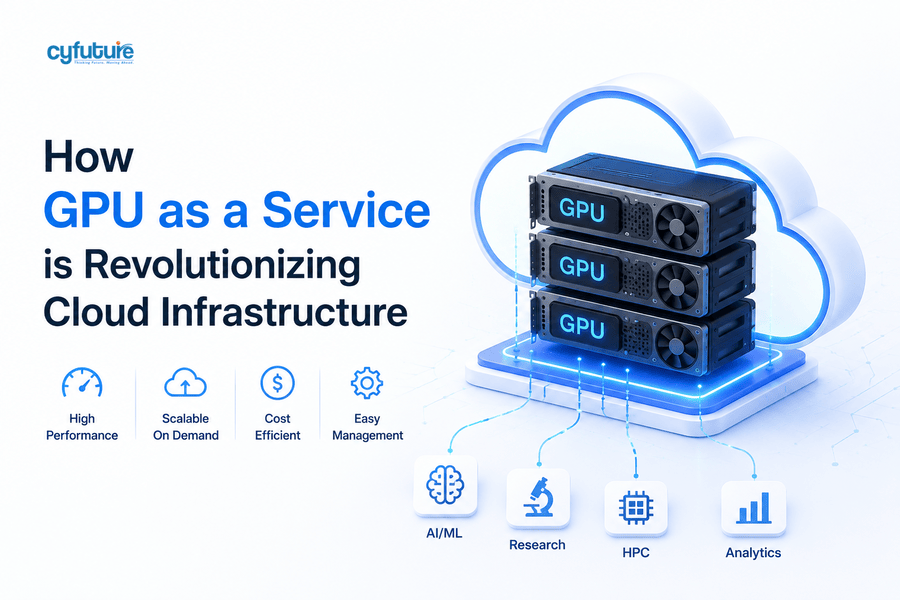
This challenge has paved the way for GPU as a Service (GPUaaS), a cloud-based model that provides on-demand access to powerful Graphics Processing Units (GPUs) without requiring organizations to invest in expensive hardware. By combining the computational power of GPUs with the flexibility of cloud computing, GPUaaS is revolutionizing cloud infrastructure and enabling businesses of all sizes to accelerate innovation.
In this blog, we explore how GPU as a Service is transforming cloud environments, its benefits, use cases, and why it is becoming a critical component of modern digital infrastructure.
GPU as a Service (GPUaaS) is a cloud computing solution that allows organizations to rent GPU resources on-demand through the cloud. Instead of purchasing and maintaining costly GPU hardware, businesses can access high-performance GPUs through a subscription or pay-as-you-go model.
Cloud providers manage the infrastructure, hardware maintenance, upgrades, security, and scalability, allowing organizations to focus on developing applications and extracting business value.
GPUaaS is particularly useful for workloads that require parallel processing, including:
Modern applications generate massive amounts of data that need to be processed in real-time. Traditional CPU-centric infrastructure faces several challenges:
CPUs are designed for sequential processing. Complex AI models and large datasets require thousands of simultaneous calculations, which CPUs cannot efficiently handle.
Purchasing enterprise-grade GPUs requires significant upfront investment. Organizations must also account for maintenance, cooling, power consumption, and periodic hardware upgrades.
Business demands fluctuate. Organizations may require hundreds of GPUs during peak periods but only a fraction during normal operations.
Managing GPU clusters internally requires specialized expertise, creating operational challenges and increasing IT costs.
GPUaaS addresses these limitations by delivering scalable, high-performance GPU resources through the cloud.
AI and ML applications depend heavily on computational power. Training modern AI models can take weeks or months using traditional CPU infrastructure.
GPUs dramatically reduce training times by performing thousands of calculations simultaneously. Through GPUaaS, organizations can instantly access powerful GPU clusters capable of handling complex AI workloads.
Benefits include:
This capability allows businesses to innovate more rapidly and gain a competitive advantage.
One of the most significant advantages of GPUaaS is its cost-effectiveness.
Instead of spending millions on GPU hardware, organizations only pay for the resources they use. This consumption-based model eliminates:
Businesses can allocate resources more strategically while maintaining access to cutting-edge GPU technology.
Scalability is a fundamental requirement in modern cloud infrastructure.
GPUaaS enables organizations to:
This elasticity ensures optimal performance without overprovisioning infrastructure.
For example, an AI startup may require hundreds of GPUs during model training but only a few GPUs for ongoing inference. GPUaaS makes this transition seamless.
The rise of Generative AI has significantly increased demand for GPU computing.
Applications such as:
require substantial computational resources.
GPUaaS provides the high-performance environment needed to efficiently train and deploy Large Language Models (LLMs). Businesses can access enterprise-grade GPU clusters without building their own AI infrastructure.
Organizations generate enormous volumes of data every day.
Traditional analytics systems often struggle to process these datasets quickly. GPUs can perform parallel computations across large datasets, significantly reducing processing times.
GPUaaS enables:
Companies can gain valuable insights faster and respond more effectively to market changes.
Traditional infrastructure often results in underutilized hardware.
Organizations purchase hardware based on peak demand, leaving expensive resources idle during normal operations.
GPUaaS eliminates this inefficiency by allowing businesses to consume resources only when needed.
Advantages include:
This model aligns perfectly with modern cloud computing principles.
Healthcare organizations use GPUaaS for:
High-performance GPUs help researchers process complex datasets faster and improve patient outcomes.
Banks and financial institutions leverage GPUaaS for:
Real-time data processing enhances accuracy and decision-making.
Manufacturers use GPU-powered simulations and AI-driven analytics to:
GPUaaS enables:
Content creators can complete projects faster and more efficiently.
Self-driving technologies depend heavily on AI and computer vision.
GPUaaS provides the computational resources needed for:
Modern enterprises increasingly adopt hybrid and multi-cloud architectures.
GPUaaS integrates seamlessly into these environments by providing:
Organizations can deploy GPU workloads wherever they achieve the best performance and cost efficiency.
This flexibility is essential for enterprises operating across multiple cloud environments.
Leading GPUaaS providers implement enterprise-grade security measures, including:
Organizations benefit from secure GPU infrastructure while avoiding the complexity of managing security internally.
This is particularly valuable for industries with strict regulatory requirements such as healthcare, finance, and government sectors.
As AI adoption continues to accelerate, businesses need reliable, scalable, and high-performance GPU infrastructure.
Cyfuture GPU as a Service offers organizations access to enterprise-grade GPU resources designed for AI, machine learning, deep learning, data analytics, and high-performance computing workloads.
Key advantages include:
By eliminating the complexities of hardware ownership, Cyfuture enables organizations to focus on innovation while maximizing performance and efficiency.
The future of GPUaaS is closely tied to advancements in AI and cloud computing.
Key trends include:
Cloud providers will increasingly use AI to optimize GPU allocation and workload management.
GPUaaS will support edge computing environments where AI applications require real-time processing closer to users.
Demand for GPU resources will continue to grow as businesses deploy generative AI applications across industries.
Advanced GPU technologies and energy-efficient data centers will reduce the environmental impact of high-performance computing.
GPUaaS will make powerful AI infrastructure accessible to startups, small businesses, and research institutions worldwide.
GPU as a Service is fundamentally transforming cloud infrastructure by providing organizations with scalable, cost-effective, and high-performance computing resources. From accelerating AI and machine learning to enabling real-time analytics and supporting generative AI applications, GPUaaS is becoming an essential component of modern digital transformation strategies.
As businesses continue to adopt AI-driven technologies, the demand for flexible GPU resources will only increase. Organizations that embrace GPUaaS can reduce costs, improve operational efficiency, accelerate innovation, and gain a significant competitive advantage.
Solutions such as Cyfuture GPU as a Service empower businesses to harness the full potential of GPU computing without the burden of infrastructure ownership, making advanced computing capabilities more accessible than ever before.
The future of cloud infrastructure is intelligent, scalable, and GPU-powered—and GPU as a Service is leading the way.
GPU as a Service (GPUaaS) is a cloud-based solution that provides on-demand access to powerful GPU resources without requiring businesses to purchase and maintain expensive hardware. Users can rent GPU capacity as needed and pay only for what they use.
GPUaaS significantly accelerates AI and machine learning workloads by enabling parallel processing. This reduces model training times, improves performance, and allows organizations to develop and deploy AI applications more efficiently.
Yes. GPUaaS eliminates large upfront hardware investments, maintenance costs, and infrastructure management expenses. Businesses can scale resources based on demand and pay only for the GPU capacity they consume.
Industries such as healthcare, finance, manufacturing, media and entertainment, research, autonomous vehicles, and e-commerce benefit greatly from GPUaaS due to their high-performance computing and AI requirements.
GPUaaS supports the growing demand for AI, machine learning, big data analytics, and generative AI applications. It provides scalable, flexible, and high-performance computing resources that help organizations innovate faster while optimizing costs and infrastructure efficiency.