 362 Views
Enterprise artificial intelligence is moving beyond experimental projects toward production workloads such as generative AI, large language model (LLM) inference, computer vision, recommendation systems, digital twins, scientific computing, and AI-powered automation. As these workloads become more complex, businesses need GPU infrastructure that combines high compute performance, large memory capacity, security, scalability, and reliable data-centre operation.
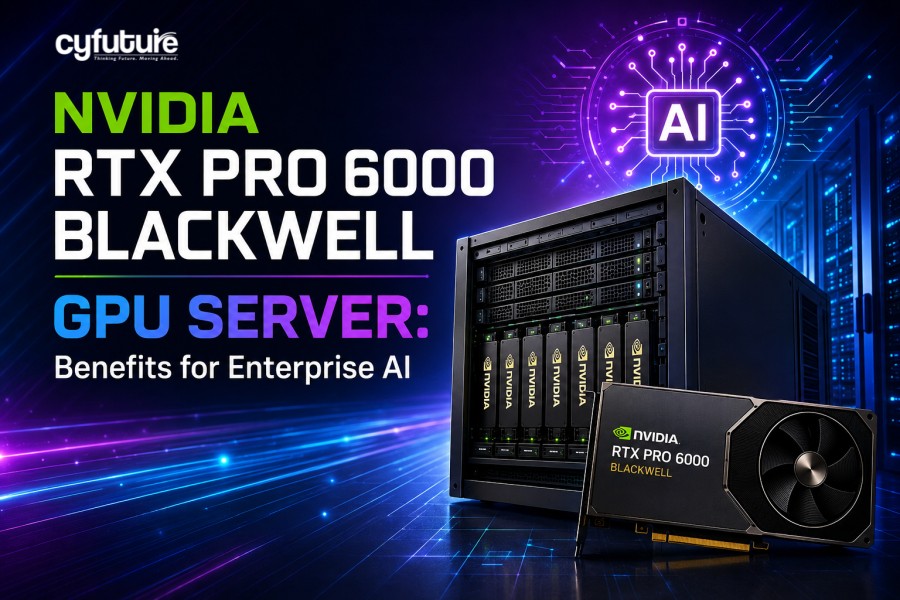
The NVIDIA RTX PRO 6000 Blackwell Server Edition is designed for this type of environment. Built on the NVIDIA Blackwell architecture, it combines AI acceleration and professional graphics capabilities in a server-oriented GPU. It features 96GB of GDDR7 ECC memory, 24,064 CUDA cores, fifth-generation Tensor Cores, fourth-generation RT Cores, and up to 1,597 GB/s of memory bandwidth.
For enterprises building AI infrastructure, the RTX PRO 6000 Blackwell can provide a versatile platform for both AI and graphics-intensive workloads.
The NVIDIA RTX PRO 6000 Blackwell Server Edition is a data-centre GPU designed to accelerate enterprise AI, visual computing, simulation, and other demanding workloads. Unlike GPUs designed primarily for consumer systems, the Server Edition is intended for continuous operation in data-centre environments and supports passive cooling, multi-GPU server configurations, NVIDIA AI Enterprise, NVIDIA Omniverse, virtual workstations, and Multi-Instance GPU (MIG).
Its 96GB GDDR7 memory provides substantial capacity for AI models, datasets, visualisation workloads, and other memory-intensive applications. NVIDIA also supports configurations using multiple RTX PRO 6000 GPUs, including 2-, 4-, and 8-GPU systems.
Some of the important specifications of the RTX PRO 6000 Blackwell Server Edition include:
| Specification | NVIDIA RTX PRO 6000 Blackwell Server Edition |
|---|---|
| Architecture | NVIDIA Blackwell |
| CUDA Cores | 24,064 |
| GPU Memory | 96GB GDDR7 ECC |
| Memory Interface | 512-bit |
| Memory Bandwidth | Up to 1,597 GB/s |
| RT Cores | 188, 4th Generation |
| Tensor Cores | 5th Generation |
| FP4 Tensor Performance | Up to 4 PFLOPS |
| FP8 Tensor Performance | Up to 2 PFLOPS |
| FP16/BF16 Tensor Performance | Up to 1 PFLOP |
| FP32 Performance | Up to 120 TFLOPS |
| Power | Up to 600W, configurable |
| Interface | PCIe Gen 5 x16 |
These specifications make the GPU suitable for workloads that require substantial memory capacity and high-throughput AI processing.
One of the most important advantages is its 96GB of GDDR7 ECC memory. Enterprise AI workloads can quickly become memory-intensive as organisations work with larger models, longer context windows, high-resolution datasets, and multimodal inputs.
The large memory capacity can help businesses run larger AI workloads on individual GPUs while reducing the need to divide workloads unnecessarily across multiple devices. NVIDIA also specifies ECC memory for the Server Edition, supporting reliability for professional and enterprise workloads.
Generative AI applications require significant GPU acceleration, particularly when businesses deploy LLMs and multimodal models at scale.
The RTX PRO 6000 Blackwell includes fifth-generation Tensor Cores and Blackwell’s Transformer Engine capabilities, including support for FP4 precision. These technologies are designed to accelerate AI inference and improve performance for modern AI workloads.
NVIDIA reports that, compared with the previous-generation L40S, the RTX PRO 6000 Blackwell Server Edition can provide up to 5x higher LLM inference throughput for agentic AI applications in its stated benchmarks. Actual results will depend on the model, software stack, batch size, precision, and deployment configuration.
Enterprise AI is increasingly moving toward agentic systems that can reason, retrieve information, use tools, and perform multi-step tasks.
The RTX PRO 6000 is designed to support production AI applications through NVIDIA AI Enterprise, including LLM inference, AI agents, computer vision, speech AI, and generative AI. This makes it a potential infrastructure choice for organisations developing internal AI assistants, autonomous workflows, intelligent search, and enterprise copilots.
GPU resources are expensive, so enterprise data centres need ways to improve utilisation.
The RTX PRO 6000 Blackwell Server Edition supports Multi-Instance GPU (MIG). NVIDIA states that one GPU can be partitioned into as many as four isolated instances of 24GB each. This can allow organisations to allocate GPU resources to multiple workloads or users instead of dedicating the entire GPU to a single smaller task.
For cloud providers, AI labs, and enterprise IT teams, this capability can be particularly useful for workload isolation and resource sharing.
Security is a major consideration when enterprises process proprietary models, customer information, financial data, or intellectual property.
The RTX PRO 6000 Blackwell Server Edition supports NVIDIA Confidential Computing, which is designed to provide hardware-based protection for AI models and sensitive data while they are in use.
This can be valuable for industries where AI workloads involve confidential or regulated information.
Many enterprise workloads do not involve AI alone. Businesses may need AI inference, 3D visualisation, simulation, rendering, digital twins, and video processing within the same infrastructure.
The RTX PRO 6000 is designed as a universal GPU combining AI and professional graphics capabilities. NVIDIA positions it for applications including generative AI, physical AI, scientific computing, rendering, 3D graphics, and video.
This can help organisations consolidate different GPU workloads onto a more versatile infrastructure platform.
Physical AI is becoming increasingly important in manufacturing, robotics, automotive engineering, and industrial simulation.
The RTX PRO 6000 can accelerate NVIDIA Omniverse-based workloads involving OpenUSD, synthetic data generation, robotics workflows, and digital twins. This makes it relevant for businesses developing AI systems that interact with or simulate physical environments.
For example, an automotive company could use GPU infrastructure for AI model development alongside simulation and 3D visualisation workflows.
Enterprise AI rarely stops at one GPU. Large deployments may require multiple GPUs connected within a server or across a cluster.
NVIDIA provides RTX PRO Server designs using configurations such as 2-, 4-, and 8-GPU systems. Its reference architectures also describe 8-GPU configurations designed for enterprise AI infrastructure.
An 8-GPU configuration can provide 768GB of aggregate GPU memory when each GPU has 96GB, although aggregate memory does not automatically behave as one unified memory pool for every application. NVIDIA’s reference architecture cites up to 12.8 TB/s aggregate memory bandwidth for such an 8-GPU configuration.
Enterprise AI teams often need infrastructure for more than inference. They may also perform model evaluation, fine-tuning, experimentation, and development.
The RTX PRO 6000 Blackwell Server Edition is positioned for workloads including inference and fine-tuning, alongside distributed rendering and HPC applications.
Its 96GB memory capacity can be especially useful for memory-demanding fine-tuning and experimentation workloads, although the practical model size and training configuration will depend on the framework, precision, optimisation technique, and number of GPUs.
Another advantage is the ability to support virtualised GPU environments.
NVIDIA vGPU software can be used with RTX PRO 6000 Blackwell Server Edition GPUs to support virtual workstations and shared AI and graphics workloads. NVIDIA’s vGPU documentation highlights MIG and virtualisation capabilities for improving scalability and resource utilisation in data-centre environments.
This can allow organisations to deliver GPU-accelerated environments to multiple teams without necessarily assigning a dedicated physical GPU to every user.
The RTX PRO 6000 Blackwell can support a broad range of enterprise applications, including:
NVIDIA specifically highlights industries such as architecture, automotive, cloud services, financial services, healthcare, manufacturing, media and entertainment, and retail as potential users of the RTX PRO 6000 platform.
Traditional CPU-based servers remain useful for many enterprise applications, but AI workloads can benefit significantly from GPU acceleration.
A CPU server may be suitable for databases, application hosting, business logic, and general-purpose computing. GPU servers become more valuable when workloads involve massive parallel processing, neural-network inference, model development, graphics rendering, simulation, or large-scale data processing.
The RTX PRO 6000 Blackwell therefore works best as part of an accelerated computing architecture rather than as a universal replacement for CPUs.
Despite its capabilities, enterprises should evaluate several factors before investing in an RTX PRO 6000 Blackwell GPU server.
Workload requirements: Determine whether your workloads need 96GB of GPU memory and Blackwell-level acceleration.
Software compatibility: Verify compatibility with CUDA, AI frameworks, inference engines, virtualisation software, and enterprise applications.
Power and cooling: The Server Edition can consume up to 600W, so appropriate server power delivery and thermal infrastructure are essential.
Networking: Multi-GPU and distributed AI workloads can require high-speed networking and appropriate server architecture.
Scalability: Decide whether you need a single GPU, a multi-GPU server, or a larger cluster.
Total cost of ownership: Evaluate GPU acquisition, server hardware, electricity, cooling, software, maintenance, networking, and operational costs rather than considering GPU price alone.
The NVIDIA RTX PRO 6000 Blackwell GPU Server is designed to address the growing demand for enterprise AI infrastructure that can handle both compute-intensive AI workloads and professional visual applications.
Its combination of 96GB GDDR7 ECC memory, Blackwell architecture, fifth-generation Tensor Cores, FP4 support, MIG, Confidential Computing, and multi-GPU scalability makes it a strong option for organisations developing generative AI, agentic AI, computer vision, digital twins, simulation, and other advanced workloads.
For enterprises, the biggest value is its versatility: the same GPU platform can support AI inference, fine-tuning, visual computing, virtual workstations, simulation, and physical AI. However, organisations should match the GPU configuration to their actual workload, software stack, networking requirements, power infrastructure, and budget.
The NVIDIA RTX PRO 6000 Blackwell Server Edition is a data-centre GPU built on the Blackwell architecture for enterprise AI, visual computing, simulation, rendering, and other demanding workloads. It features 96GB of GDDR7 ECC memory.
It has 96GB of GDDR7 ECC GPU memory with a 512-bit memory interface and up to 1,597 GB/s of memory bandwidth.
Yes. It is designed to accelerate LLM inference and other generative and agentic AI workloads. NVIDIA reports up to 5x higher LLM inference throughput than the L40S for certain agentic AI benchmarks, although real-world performance varies by workload and configuration.
Yes. The GPU supports NVIDIA vGPU software and MIG capabilities, enabling GPU resources to be shared and isolated across multiple workloads and users.
Enterprises can consider it when they need a versatile GPU platform for AI inference, fine-tuning, generative AI, computer vision, digital twins, simulation, rendering, and virtualised workloads. Its large 96GB memory capacity and Blackwell AI capabilities make it particularly suitable for demanding enterprise applications.