 206 Views
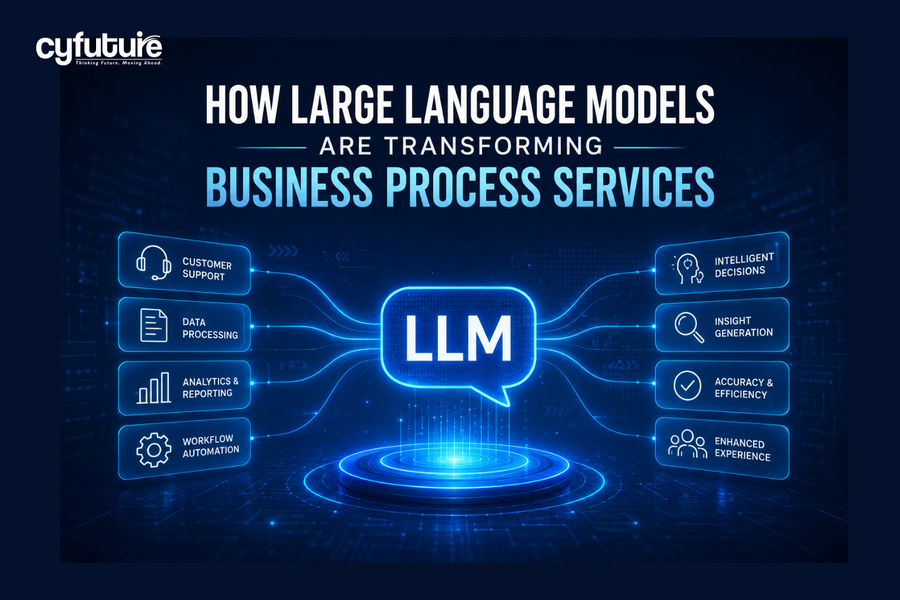
Business Process Services (BPS) are undergoing a major transformation as organisations adopt Artificial Intelligence (AI) to improve efficiency, customer experience, accuracy and scalability. Among the most influential technologies driving this change are Large Language Models (LLMs).
LLMs can understand and generate human-like language, analyse large volumes of information, summarise documents, respond to customer queries, classify content and assist employees with complex knowledge-based tasks. Unlike traditional automation, which generally follows predefined rules, LLM-powered systems can work with unstructured information and adapt their responses to different situations.
This capability is particularly valuable for Business Process Services, where organisations manage repetitive, information-intensive and customer-facing activities across finance, customer support, human resources, procurement, healthcare, logistics and other industries.
Research from McKinsey highlights that generative AI and agentic AI are increasingly being applied across the operations value chain, with organisations moving beyond experimentation towards workflow redesign and scalable implementation.
Large Language Models are AI systems trained on extensive datasets to understand, process and generate natural language. Modern LLMs can perform tasks such as answering questions, summarising information, extracting insights, drafting content, translating text and assisting with decision-making.
In a BPS environment, an LLM can be connected with enterprise applications, knowledge bases, customer relationship management platforms and workflow automation tools. This enables AI to become part of an operational process rather than functioning as an isolated chatbot.
For example, instead of an employee manually reading hundreds of customer emails and categorising them, an LLM can analyse the messages, identify the intent, extract relevant information and route each request to the appropriate team.
IBM has demonstrated how LLM capabilities can be embedded directly into business process workflows, allowing AI tasks to work with existing process variables and business information.
Traditional BPS models often rely on large teams to handle repetitive tasks. While these services can deliver cost and operational benefits, organisations increasingly expect faster turnaround times, higher accuracy, personalised experiences and 24/7 availability.
LLMs introduce an additional layer of intelligence to automation.
They can help BPS providers move from task automation to intelligent process management. Instead of simply executing predefined instructions, AI-enabled workflows can understand context, process unstructured information and support employees in making faster decisions.
The impact can be seen across several important areas.
Customer support is one of the most significant applications of LLMs in BPS.
AI-powered assistants can understand customer questions, analyse conversation history and provide relevant responses using natural language. They can support customers through chat, email and other digital channels while escalating complex or sensitive cases to human agents.
LLMs can also assist human customer service representatives by providing suggested responses, summarising previous interactions and retrieving relevant information from internal knowledge bases.
Research cited by McKinsey found that generative AI assistance at one company with 5,000 customer-service agents increased issues resolved per hour by 14% and reduced handling time by 9%.
For BPS providers, this means AI can augment human agents rather than simply replace them. Employees can focus on complicated cases that require empathy, negotiation, or judgement while AI handles routine interactions.
Business Process Services involve enormous amounts of documents, including invoices, contracts, claims, applications, purchase orders, and reports.
Historically, extracting information from these documents required manual data entry or rule-based optical character recognition systems.
LLMs and generative AI can make document processing more intelligent. They can identify relevant information, summarise documents, classify content and help determine what action should happen next.
AWS, for example, has expanded generative-AI-based intelligent document processing capabilities with features including human-in-the-loop review, business-rule validation, document discovery and custom model integration.
For BPS organisations, this can reduce manual effort and accelerate document-intensive workflows.
Finance departments manage numerous repetitive processes, including invoice processing, payment queries, expense reviews, financial reporting and reconciliation.
LLMs can assist by extracting information from invoices, categorising requests, generating summaries and answering questions about financial documentation.
For example, an AI-enabled accounts-payable workflow could receive an invoice, extract supplier and payment information, compare the information against business rules and route exceptions to a finance employee.
This creates a more streamlined process while allowing human specialists to focus on exceptions and higher-value financial activities.
HR is another area where LLM-powered BPS solutions can provide significant value.
Employees frequently ask questions about leave policies, benefits, payroll procedures, onboarding and internal policies. An AI assistant connected to an approved organisational knowledge base can answer routine questions quickly.
LLMs can also assist HR teams with:
However, HR applications require careful governance because employee information can be sensitive. Organisations should establish appropriate access controls, data-protection measures and human review processes.
Procurement teams deal with supplier communications, contracts, purchase orders and large amounts of unstructured information.
LLMs can analyse supplier documents, summarise contract clauses, identify relevant information and help procurement employees prepare communications.
Agentic AI takes this capability further by coordinating multiple steps within a workflow. McKinsey notes that AI agents can support complex business workflows involving multiple steps, systems and participants, while potentially reducing delays between sequential tasks.
For BPS providers, this creates opportunities to deliver more intelligent procurement and supply-chain services instead of simply performing individual administrative tasks.
One of the biggest challenges in BPS is helping employees find the right information quickly.
Organisations may have thousands of documents, standard operating procedures, FAQs, training manuals and internal policies. Searching these resources manually can consume significant time.
LLM-powered knowledge assistants can allow employees to ask questions in natural language and receive contextual answers based on approved organisational information.
This can improve employee productivity, reduce repetitive internal queries and make institutional knowledge easier to access.
Quality assurance is essential in outsourced business processes.
LLMs can analyse customer interactions, emails, case notes and other operational records to identify potential errors or inconsistencies.
For example, an AI system can review customer conversations to identify whether required information was provided, whether the correct process was followed and whether the interaction should be reviewed by a supervisor.
This allows BPS providers to move from sampling a small percentage of transactions towards broader AI-assisted quality monitoring.
Global organisations frequently need customer and back-office services in multiple languages.
LLMs can support translation, multilingual customer interactions and content generation. This can help BPS providers serve international customers without creating completely separate technology environments for every language.
However, language quality should be tested carefully for industry-specific terminology, regional expressions and sensitive communications.
The most important development may be the transition from isolated AI tasks to connected AI workflows.
Traditional automation typically performs a specific action based on predefined rules. LLM-powered systems can interpret information and determine what type of action may be appropriate.
For example:
Customer email → Intent detection → Information extraction → Knowledge retrieval → Response generation → Workflow update → Human escalation if required
This creates a more intelligent process chain.
IBM research also identifies LLMs as an important component of AI-augmented business process management and explores how LLMs can help explain business processes in a context-aware manner.
When implemented appropriately, LLMs can provide several benefits:
AI can handle repetitive information-processing activities, allowing employees to spend more time on complex tasks.
Automated systems can process requests continuously, including outside traditional working hours.
AI assistants can provide faster and more consistent responses while helping human agents resolve complex issues.
Businesses can process increasing volumes without necessarily increasing staffing at the same rate.
Employees can interact with organisational knowledge through natural-language interfaces.
AI can analyse large volumes of process data and identify recurring issues, trends and opportunities for improvement.
Despite their potential, LLMs are not a plug-and-play replacement for existing business processes.
BPS providers often handle confidential customer, financial and business information. Organisations need strong data governance, access controls, encryption and appropriate deployment architectures.
LLMs can sometimes generate incorrect information. Critical processes therefore require validation, reliable knowledge sources and human oversight.
Industries such as finance, healthcare and insurance have strict regulatory requirements. AI systems must be designed around applicable privacy and compliance obligations.
The value of an LLM depends on how effectively it connects with existing CRM, ERP, ticketing, workflow and document-management systems.
Employees need training to work effectively with AI. McKinsey research indicates that organisations scaling AI are redesigning workflows, strengthening governance and developing new AI-related skills.
The future of BPS is likely to involve a combination of human expertise, conventional automation, generative AI and agentic AI.
LLMs will increasingly become embedded inside business applications and workflows rather than being used only through standalone chat interfaces. AI agents may coordinate multiple process steps, retrieve information, communicate with customers, update systems and escalate exceptions.
At the same time, human involvement will remain important for decisions involving judgement, accountability, empathy and regulatory responsibility.
The organisations that gain the most value will therefore not simply deploy an LLM. They will redesign business processes around clearly defined outcomes, reliable data, governance and human-AI collaboration.
Large Language Models are changing Business Process Services by bringing natural-language understanding and generative intelligence into everyday operations. From customer support and document processing to finance, HR, procurement and knowledge management, LLMs can help organisations improve productivity, responsiveness and scalability.
The next stage will go beyond simple chatbot deployments. As LLMs become integrated with workflow platforms and AI agents, BPS providers can create intelligent processes capable of understanding information, coordinating tasks and supporting employees throughout the customer and operational lifecycle.
However, successful implementation requires more than technology. Organisations need strong data governance, security, integration, process redesign and human oversight.
For businesses prepared to adopt AI strategically, LLMs can transform BPS from a primarily labour-intensive model into a more intelligent, scalable and outcome-focused operating model.
Large Language Models are AI systems that understand and generate natural language. In BPS, they can automate or assist activities such as customer support, document processing, knowledge management, reporting and workflow operations.
LLMs can understand customer questions, generate responses, summarise previous interactions, and assist human agents with relevant information. This can improve response speed and help agents handle more complex customer issues.
LLMs are more commonly used to augment employees by automating repetitive tasks and assisting with information-intensive work. Human employees remain important for complex decisions, relationship management, exceptions, and tasks requiring judgement.
Key risks include inaccurate AI-generated information, data privacy concerns, security vulnerabilities, regulatory issues, and poor integration with existing systems. Human oversight and appropriate governance are essential for high-impact processes.
The future is likely to involve AI-powered workflow orchestration, intelligent document processing, AI assistants and agentic systems that can coordinate multiple process steps. Organisations will increasingly combine LLMs with automation and human expertise to create scalable business operations.