 296 Views
In today’s digital-first economy, businesses are expected to deliver instant responses, personalized interactions, and seamless experiences across every touchpoint. What was once considered a simple website chat window has now evolved into a powerful, AI-driven business engine.
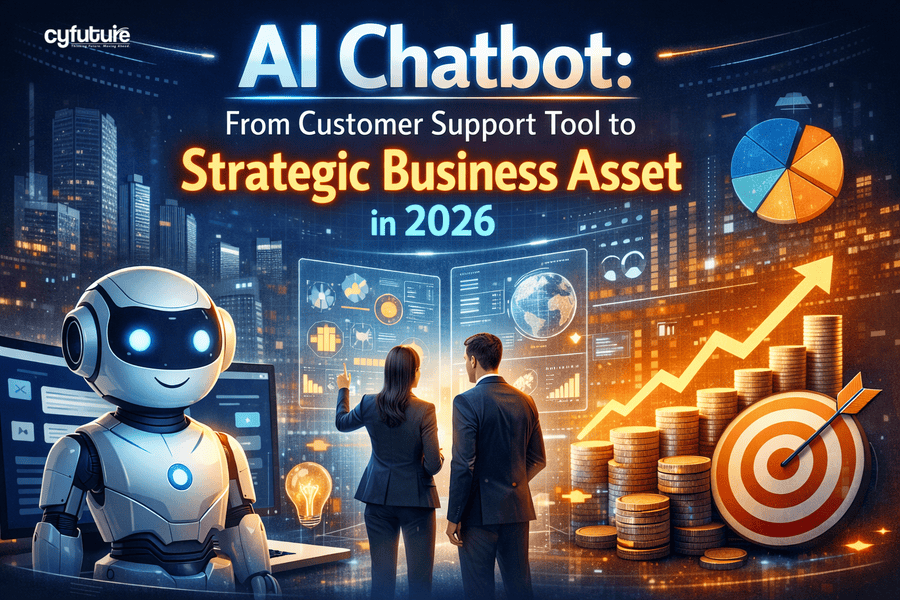
An AI chatbot is no longer just a support tool—it is a strategic business asset that enhances customer engagement, reduces operational costs, boosts productivity, and enables scalable growth.
From handling customer queries to generating leads and automating internal workflows, AI chatbots have transformed the way enterprises operate. In this comprehensive guide, we’ll explore what an AI chatbot is, how it works, its enterprise use cases, benefits, implementation best practices, and why it’s becoming a competitive necessity in 2026 and beyond.
An AI chatbot is an advanced software application that uses artificial intelligence technologies such as:
Unlike traditional rule-based bots that rely on predefined scripts, AI chatbots understand context, interpret user intent, and continuously improve from interactions.
For enterprises, this means scalable automation that adapts as business complexity grows.
Customers today expect instant support—anytime, anywhere. At the same time, businesses are under constant pressure to:
AI chatbots address all of these challenges effectively.
Modern consumers:
AI chatbots deliver on these expectations while helping businesses operate more efficiently.
Behind the scenes, several technologies work together to power intelligent conversations.
NLP enables the chatbot to:
This allows conversations to feel natural and meaningful.
Machine learning enables chatbots to:
The more data they process, the smarter they become.
Modern AI chatbots are powered by generative AI models capable of:
This makes enterprise chatbots more dynamic and intelligent than ever before.
AI chatbots integrate with:
This allows chatbots to take real actions—like updating tickets, scheduling meetings, retrieving account data, or processing requests.
AI chatbots are no longer limited to customer support. They are deployed across departments and industries.
Customer service remains the most common AI chatbot application.
AI chatbots can:
Organizations using AI chatbots often report significant reductions in repetitive queries handled by human agents.
AI chatbots act as 24/7 digital sales assistants.
They can:
For B2B enterprises, chatbots significantly improve marketing ROI.
AI chatbots are transforming internal operations.
Common use cases include:
Internal AI chatbots create operational efficiency at scale.
AI chatbots are customized for various industries:
Healthcare
Retail & E-Commerce
Manufacturing
SaaS & Technology
Industry-trained AI chatbots deliver higher accuracy and deeper business impact.
| Traditional Chatbot | AI Chatbot |
| Rule-based scripts | AI-driven intelligence |
| Keyword matching | Intent recognition |
| Limited responses | Context-aware conversations |
| No learning ability | Continuous improvement |
| Breaks easily | Scales with complexity |
Traditional bots struggle with dynamic conversations. AI chatbots evolve with your business.
Satisfied customers are more likely to remain loyal.
Automating repetitive tasks significantly lowers:
AI chatbots help businesses optimize resources without sacrificing quality.
Unlike human teams, chatbots can handle thousands of simultaneous conversations without additional hiring.
This makes them ideal for:
AI chatbots generate valuable analytics, such as:
These insights drive better decision-making.
Security and Compliance Considerations
As AI chatbots manage sensitive data, security is critical.
Enterprise-grade AI chatbot solutions include:
Building trust is essential for long-term adoption.
Despite their benefits, AI chatbot adoption requires careful planning.
Common challenges include:
Successful implementation requires aligning technology with business strategy.
To maximize ROI, enterprises should:
Identify measurable goals such as ticket reduction or lead conversion improvement.
Focus on repetitive, high-volume queries first.
Train chatbots using actual customer conversations.
Ensure connectivity with CRM, ERP, and support tools.
Use analytics to refine responses and improve accuracy.
A phased, strategic rollout typically delivers better long-term results.
AI chatbot technology is evolving rapidly.
Advanced language models enable:
Chatbots are becoming smarter and more human-like.
Voice bots are expanding capabilities into:
This enhances omnichannel engagement.
Next-generation chatbots will:
This shifts chatbots from reactive systems to intelligent digital assistants.
Final Thoughts: AI Chatbot as a Competitive Advantage
An AI chatbot is no longer optional—it is a strategic necessity.
Enterprises that embrace AI chatbot technology gain:
The real power of AI chatbots lies not in replacing humans but in augmenting them—allowing teams to focus on high-value tasks while automation handles the repetitive workload.
Organizations that invest thoughtfully in AI chatbot solutions today will be better positioned to compete in a digital, experience-driven marketplace tomorrow.
An AI chatbot is a software application powered by artificial intelligence technologies such as Natural Language Processing (NLP) and Machine Learning (ML). It can understand user intent, respond in a human-like manner, and improve over time through continuous learning. Unlike rule-based bots, AI chatbots can manage contextual, multi-step conversations.
Traditional chatbots operate on predefined rules and scripted responses, while AI chatbots use advanced algorithms to understand context, intent, and sentiment. AI chatbots learn from past interactions and become more accurate over time, whereas traditional bots cannot adapt beyond their programmed responses.
AI chatbots work using a combination of:
These technologies allow chatbots to interpret requests, retrieve relevant information, and deliver accurate responses.
AI chatbots provide several business benefits, including:
They also generate valuable data insights for business improvement.
AI chatbots are designed to assist and augment human agents, not fully replace them. They handle repetitive and high-volume queries, allowing human agents to focus on complex, sensitive, or high-value interactions. A hybrid model combining AI and human support delivers the best results.
Yes, enterprise-grade AI chatbots are built with strong security features such as:
Security and privacy are critical components of modern chatbot deployment.
AI chatbots are widely used across industries, including:
Any organization that handles customer or employee queries can benefit from AI chatbot implementation.
AI chatbots enhance customer experience by:
This leads to higher satisfaction and stronger brand loyalty.
Common challenges include:
A well-planned strategy and phased deployment can help overcome these challenges.
The future of AI chatbots includes:
AI chatbots are evolving into intelligent digital assistants that support both customers and employees.