 337 Views
Enterprise AI is moving rapidly from experimentation to production. Businesses are deploying large language models (LLMs), generative AI applications, AI agents, computer vision systems, recommendation engines, and real-time inference platforms that require significantly more computing power than traditional infrastructure can provide.
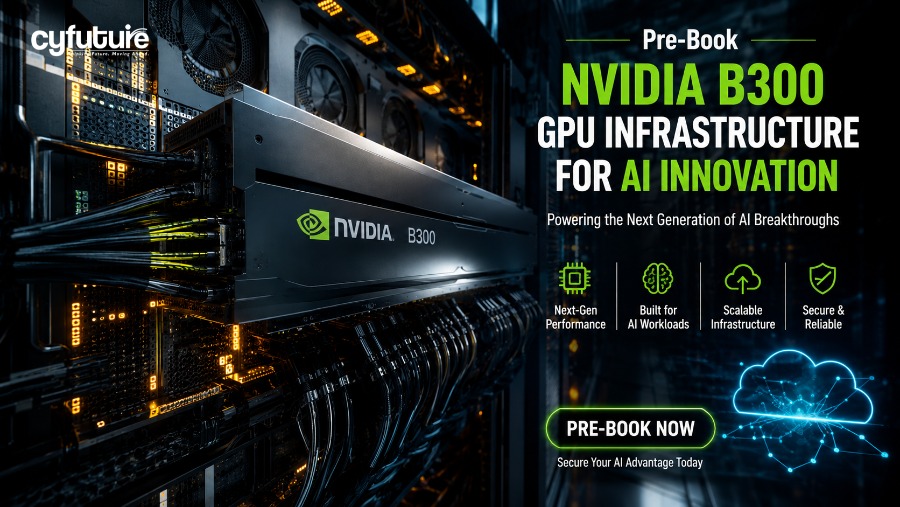
The NVIDIA B300 GPU, based on the Blackwell Ultra architecture, is designed for this new generation of AI workloads. NVIDIA’s DGX B300 platform combines eight Blackwell Ultra GPUs with 2.1 TB of total GPU memory and up to 144 PFLOPS of FP4 Tensor Core performance. NVIDIA also highlights the platform’s focus on AI reasoning, inference, and training.
For enterprises, however, purchasing and operating this class of infrastructure can require substantial capital investment, specialized data-center capabilities, and ongoing technical management. Renting NVIDIA B300 GPUs provides an alternative by giving organizations access to high-performance AI infrastructure on demand.
NVIDIA B300 GPU rental is a cloud or dedicated infrastructure model that allows businesses to access B300-powered computing resources without purchasing the underlying hardware.
Instead of investing in GPU servers, high-speed networking, cooling systems, power infrastructure, storage, and maintenance, an enterprise pays for access based on usage, reservation, or a dedicated capacity agreement.
The B300 is particularly relevant to enterprise AI because it provides a large memory footprint and high-speed interconnect capabilities designed for demanding AI workloads. Samsung SDS, for example, reports that its B300 GPU service provides 288 GB of HBM3E memory per GPU and 8 TB/s of memory bandwidth.
Depending on the provider, businesses can rent individual GPUs, multi-GPU servers, or larger dedicated clusters.
Building an enterprise-grade AI environment requires more than purchasing GPUs. Organizations may need servers, networking, storage, power delivery, cooling, software, monitoring, and specialist engineering resources.
Rental infrastructure changes this financial model from a large capital expenditure to a more flexible operating expense. Companies can access B300 infrastructure without building an entire AI data center.
This can be particularly valuable for organizations that are testing AI workloads or experiencing rapidly changing GPU requirements.
B300 is part of NVIDIA’s Blackwell Ultra generation, developed for demanding AI training and inference workloads.
NVIDIA states that DGX B300 provides 1.5x dense FP4 performance and 2x attention performance compared with DGX B200. Its published specifications include eight Blackwell Ultra SXM GPUs, 2.1 TB of total GPU memory, 144 PFLOPS of FP4 Tensor Core performance, and 14.4 TB/s of aggregate NVLink bandwidth.
For enterprises working with large models, these capabilities can help reduce processing time and support increasingly complex AI applications.
Enterprise AI workloads rarely remain constant.
A company might need a small amount of GPU capacity for development, significantly more resources during model training, and a different configuration when the application moves into production.
GPU rental allows businesses to scale infrastructure according to workload requirements. Multi-GPU deployments can be particularly useful for distributed training and high-throughput inference.
The market is already expanding around B300 cloud infrastructure, with providers offering B300 and GB300 configurations through different deployment models.
Deploying physical GPU infrastructure can involve procurement, installation, networking, software configuration, testing, and data-center integration.
Cloud-based B300 rental can shorten this process considerably. Enterprises can provision computing resources and begin configuring their AI environments without waiting for a complete hardware deployment cycle.
This is important for organizations competing in rapidly changing AI markets where development speed can directly influence time to market.
Training large language models requires substantial GPU compute, memory, and high-speed communication between accelerators.
B300 infrastructure can be used for model pre-training, continued pre-training, and other large-scale machine learning workloads.
Enterprises developing proprietary language models can rent B300 capacity during intensive training periods instead of maintaining a large permanent GPU fleet.
Not every organization needs to train an LLM from scratch.
Many enterprises fine-tune existing foundation models using proprietary datasets for customer service, finance, healthcare, legal, manufacturing, or internal knowledge applications.
B300 rental can provide the computational resources required for parameter-efficient fine-tuning, supervised fine-tuning, and other model adaptation workflows.
Enterprise AI is increasingly shifting from model development toward production inference.
AI assistants, copilots, search systems, content-generation applications, and agentic systems may need to process large numbers of requests with low latency.
Recent industry activity demonstrates this trend. In August 2026, IBM and Together AI announced a $240 million agreement involving NVIDIA HGX B300 systems for a large AI inference cluster, illustrating the growing role of B300 infrastructure in production-scale inference.
AI agents often perform multiple inference steps, call external tools, retrieve information, and reason over long contexts.
These workloads can generate considerably higher inference requirements than traditional single-response AI applications.
NVIDIA positions Blackwell Ultra specifically around the era of AI reasoning and highlights its ability to support inference and training on the same platform.
Enterprises in manufacturing, retail, logistics, security, healthcare, and transportation increasingly use AI for image and video processing.
B300 infrastructure can support computationally intensive computer vision workloads such as object detection, video analysis, image generation, medical imaging research, and automated inspection.
GPU acceleration is also important for simulations, molecular modeling, drug discovery, engineering workloads, and data-intensive research.
NVIDIA has highlighted the use of DGX B300 systems for areas including genomics, medicine, and molecular design.
The decision between renting and buying depends on workload duration, utilization, budget, and infrastructure requirements.
| Factor | Renting B300 | Buying B300 Infrastructure |
| Initial investment | Lower | Very high |
| Deployment | Faster | Requires procurement and installation |
| Scalability | Flexible | Limited by owned capacity |
| Maintenance | Usually provider-managed | Customer-managed |
| Best for | Variable or rapidly growing workloads | Consistently high utilization |
| Capital expenditure | Lower | Higher |
| Infrastructure control | Depends on provider | Maximum |
For organizations with unpredictable workloads, short-term projects, or rapidly growing AI requirements, rental can provide greater flexibility. Companies with stable, continuously utilized workloads may eventually determine that dedicated ownership provides better economics.
Memory capacity is critical for large AI models. Verify the exact GPU configuration offered by the provider and whether the advertised memory specification refers to individual GPUs or an entire server.
Multi-GPU AI workloads depend heavily on fast communication between GPUs. NVIDIA’s DGX B300 specifications include high-bandwidth NVLink and ConnectX networking designed for large-scale AI workloads.
Enterprises should therefore evaluate networking performance rather than comparing GPUs based solely on hourly price.
B300 rental pricing varies significantly depending on provider, region, instance configuration, billing model, and availability. Current public listings show substantial differences between providers, demonstrating why enterprises should compare on-demand, reserved, and dedicated pricing rather than relying on one advertised rate.
Organizations handling sensitive corporate or customer data should evaluate encryption, access controls, isolation, compliance certifications, data-retention policies, and physical data-center security.
B300 is a newer GPU platform, and capacity can vary between regions and providers. Enterprises planning large deployments should confirm availability, reservation terms, scaling limits, and expected provisioning times before committing to a project.
Enterprise AI infrastructure can involve complex software, networking, drivers, containers, orchestration, and performance optimization. A provider with 24/7 technical support can be valuable when running production workloads.
B300 rental can be particularly suitable for:
The enterprise AI infrastructure market is increasingly moving toward flexible GPU consumption models.
NVIDIA’s own materials indicate that DGX B300 can be deployed on premises, in colocation facilities, or through cloud partners. At the same time, cloud and GPU-as-a-service providers are expanding access to B300 infrastructure.
This creates a model in which enterprises do not necessarily need to own every GPU they use. Instead, they can combine on-premises infrastructure, private capacity, and rented cloud GPUs according to workload requirements.
As AI models become larger and inference workloads become more complex, access to high-memory, high-bandwidth accelerators will become increasingly important.
NVIDIA B300 GPU rental for enterprise AI offers organizations a flexible way to access next-generation computing power without making the full upfront investment associated with owning and operating advanced GPU infrastructure.
From LLM training and fine-tuning to generative AI inference, AI agents, computer vision, and scientific computing, B300 infrastructure is designed for workloads that demand substantial compute and memory capacity.
However, enterprises should look beyond GPU specifications and hourly pricing. Networking, memory, security, availability, support, scalability, and total cost of ownership are equally important when selecting a B300 GPU provider.
For organizations that need scalable AI infrastructure today while maintaining flexibility for tomorrow, renting NVIDIA B300 GPUs can be a practical strategy for moving from AI experimentation to enterprise-scale deployment.
What is NVIDIA B300 GPU rental?
NVIDIA B300 GPU rental provides businesses with temporary or dedicated access to B300-powered computing infrastructure through cloud or GPU-as-a-service providers without requiring them to purchase the hardware.
What is NVIDIA B300 used for?
B300 is designed for demanding AI workloads including LLM training, inference, generative AI, reasoning models, fine-tuning, AI agents, computer vision, and high-performance computing.
Is renting B300 better than buying it?
It depends on workload utilization. Renting is generally more flexible for variable, short-term, or growing workloads, while purchasing may make sense for organizations with consistently high GPU utilization and the resources to operate their own infrastructure.
Can enterprises rent multiple NVIDIA B300 GPUs?
Yes. Depending on provider availability, enterprises can access individual GPUs, multi-GPU servers, or dedicated clusters for distributed AI workloads.
What should enterprises check before renting B300 GPUs?
Key considerations include GPU memory, networking, pricing, availability, security, compliance, storage, scalability, software compatibility, SLA commitments, and technical support.