 2462 Views
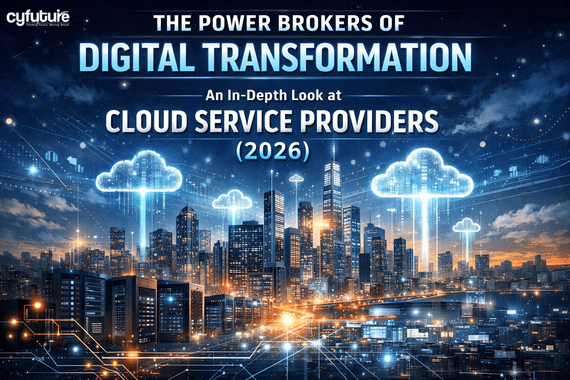
The modern business world runs on data, and the engine powering this colossal digital shift is Cloud Computing. Far from being a fleeting trend, the cloud has solidified its position as the foundational infrastructure for everything from global streaming services and enterprise AI to the simple email you check every morning. At the heart of this revolution are the Cloud Service Providers (CSPs).
These technology titans are not just offering virtual servers; they are providing a complex, intelligent ecosystem that dictates how businesses innovate, scale, and secure their operations in 2026. This article dives deep into what CSPs are, explores the dominant players, analyzes the current market dynamics, and looks ahead at the trends that will define the next wave of cloud adoption.
A Cloud Service Provider is a third-party company that offers on-demand computing services—including servers, storage, databases, networking, software, analytics, and intelligence—over the internet (“the cloud”). Businesses rent these resources on a pay-as-you-go basis, eliminating the need to own and maintain their own costly physical data centers.
The services offered by CSPs are typically categorized into three main models, forming the core of the cloud value proposition:
IaaS provides the foundational building blocks of cloud IT. Customers get access to core computing resources like virtual machines (VMs), storage (disks, object storage), and networks. The CSP manages the underlying infrastructure (servers, storage, networking hardware, and the virtualization layer), while the customer manages the operating system, middleware, and applications. This offers the maximum flexibility and management control.
PaaS is designed to simplify application development. It provides an environment that includes hardware, an operating system, storage, and networking, plus pre-configured development tools, middleware, and database management systems. Developers can focus purely on writing and deploying code without worrying about server maintenance, patching, or scaling the environment.
SaaS is the most common form of cloud service. It delivers ready-to-use software applications over the internet, typically on a subscription basis. Users simply access the application via a web browser or client application, and the CSP manages everything else—from the application itself to the underlying infrastructure. Examples include CRM systems like Salesforce, email services like Gmail, and productivity suites like Microsoft Office 365.
The global cloud infrastructure services market is characterized by the dominance of the “Big Three” Hyperscalers—providers with massive, global-scale infrastructure and nearly limitless capacity.
| Provider | Market Share (Q2 2026 Est.) | Noteworthy Features |
| Amazon Web Services (AWS) | $\approx 30\%$ | Most mature, largest service portfolio, broadest global reach, unmatched stability. |
| Microsoft Azure | $\approx 20\%$ | Strongest enterprise integration, hybrid cloud focus (Azure Arc), rapidly growing AI capabilities via OpenAI/Microsoft ecosystem. |
| Google Cloud Platform (GCP) | $\approx 13\%$ | Leader in Data Analytics (BigQuery) and AI/ML (Vertex AI), superior network, strong commitment to open source and containerization (GKE). |
Collectively, these three control well over 60% of the world’s enterprise cloud infrastructure spending.
Beyond the Big Three, providers like IBM Cloud (strong in regulated industries and hybrid cloud with Watson AI), Oracle Cloud Infrastructure (OCI) (focus on high-performance workloads and database migration), and regional players like Alibaba Cloud carve out important niches.
The competition among CSPs is driving furious innovation, with several key trends shaping the future landscape:
The integration of Artificial Intelligence and Machine Learning is no longer a separate service; it’s becoming the core differentiator. In 2026, CSPs are embedding Generative AI capabilities into every layer of the stack.
The need for ultra-low latency is pushing computation closer to the source of data, giving rise to Edge Computing. CSPs are extending their services out of the main data center and into factories, retail locations, and telecom networks. This distributed model is critical for use cases like:
The “one-size-fits-all” model is fading. CSPs are creating specialized Industry Clouds tailored with pre-built compliance frameworks, industry-specific data models, and vertical-specific applications for sectors like Finance, Healthcare, and Manufacturing. This drastically accelerates digital transformation for businesses in regulated fields.
Driven by both regulatory pressure and corporate responsibility, CSPs are making sustainability a core selling point. This involves massive investments in:
The vast majority of large enterprises now employ a Multicloud strategy, using two or more public clouds to avoid vendor lock-in and leverage best-of-breed services. CSPs are responding by offering better cross-cloud management and orchestration tools.
Furthermore, increasing data residency regulations (like GDPR) are fueling the demand for Sovereign Cloud solutions, where data and operations are strictly confined within a specific geographic or regulatory jurisdiction, often in partnership with local entities.
Despite the monumental progress, the cloud ecosystem presents several ongoing challenges for both providers and customers.
The Pay-As-You-Go model, while beneficial, can quickly lead to out-of-control spending if resources are not properly managed, monitored, and optimized (FinOps). Unused resources, suboptimal instance choices, and unexpected egress charges often catch customers off guard, making cost optimization the top challenge for many organizations.
While cloud infrastructure is inherently more secure than most on-premises setups, security in the cloud operates on a Shared Responsibility Model. The CSP secures the cloud infrastructure, but the customer is responsible for securing their data, applications, identity, and access management. Misconfigurations, weak access controls, and a lack of unified governance across multi-cloud environments are constant security risks.
The rapid pace of cloud innovation has created a significant gap between the demand for skilled Cloud Engineers, Architects, and Security Professionals and the available talent pool. Companies struggle to find experts capable of designing, migrating, and managing complex, multi-cloud, and cloud-native applications effectively.
While multicloud is the norm, truly seamless interoperability remains difficult. Switching providers can be complex, especially due to proprietary services and significant data migration costs (egress fees), which can lead to a soft form of vendor lock-in. The industry is pushing for greater adoption of open standards (like Kubernetes and open-source APIs) to mitigate this.
Selecting a CSP is one of the most critical strategic decisions for a modern business. It’s not a one-size-fits-all choice and should be based on a thorough assessment of your needs:
Cloud Service Providers are the architects of the digital age. They have democratized access to enterprise-grade technology, turning massive capital expenditures into manageable operating expenses. The future of CSPs is not just about bigger data centers; it’s about making the cloud smarter, faster, and more specialized through the integration of AI, the expansion to the edge, and a renewed focus on sustainability and compliance.
For any business, the conversation has moved from if to adopt the cloud to how to intelligently leverage multiple cloud providers, govern costs, and secure their digital assets. By understanding the core offerings, market dynamics, and emerging trends of the major Cloud Service Providers, businesses can not only keep pace with digital transformation but actively define its future.