 1922 Views
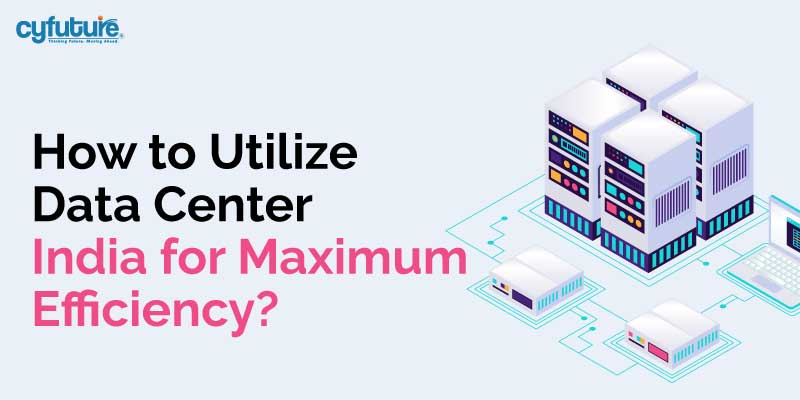
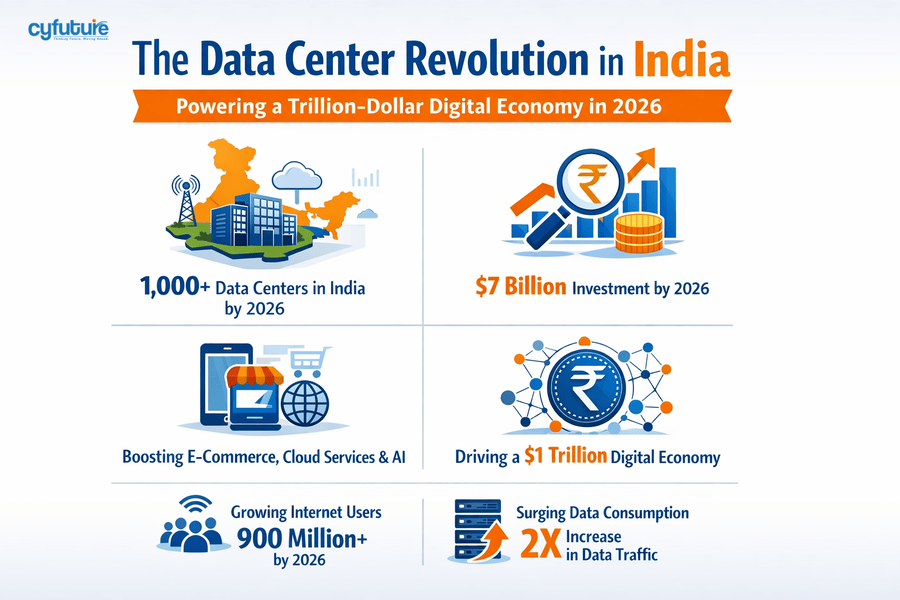
India is no longer just a participant in the global digital economy; it has become its heartbeat. As of early 2026, the nation’s data center landscape has transitioned from being a supportive backend utility to a critical national infrastructure. This shift is driven by a unique convergence of factors: the explosive growth of Generative AI, the implementation of stringent data localization laws, and the mass adoption of 5G-enabled services.
With an operational capacity surpassing 1.5 GW and projections aiming for over 2.1 GW by 2027, India is rapidly ascending the global ranks to become the data center capital of the world. This blog explores the current state of the market, the technological shifts defining 2026, and the strategic road ahead for enterprises operating in the Indian subcontinent.
The Indian data center market has matured at a staggering pace. What was once a fragmented sector dominated by small-scale enterprise server rooms has transformed into a sophisticated ecosystem of hyperscale campuses and AI-ready facilities.
The following table highlights the rapid expansion and economic impact of the sector:
| Metric | 2023 (Historical) | 2026 (Current Estimate) | 2030 (Projected) |
| Total IT Load Capacity | ~0.9 GW | ~1.6 GW | 5.0 GW – 8.0 GW |
| Market Valuation | $7.5 Billion | $12.8 Billion | $30+ Billion |
| Edge DC Capacity | 50 MW | 140 MW | 210+ MW |
| Data Consumption | 18 Exabytes/mo | 28 Exabytes/mo | 50+ Exabytes/mo |
The massive influx of capital—exceeding $32 billion in planned investments from global and domestic giants—underscores the confidence in India’s digital future.
Several distinct catalysts are fueling this unprecedented construction boom. In 2026, these drivers have moved from being “emerging trends” to “market mandates.”
The Government of India’s IndiaAI Mission has catalyzed the demand for high-performance computing (HPC). Enterprises are no longer just looking for “rack space”; they are demanding “GPU-ready” infrastructure. The surge in Generative AI applications across Indian fintech, healthcare, and retail sectors has necessitated the development of data centers capable of handling extreme power densities and specialized cooling requirements.
With the rules of the DPDP Act 2023 now fully operational as of 2025-26, data localization is no longer a choice—it is a legal requirement. Global firms operating in India must store and process the personal data of Indian citizens within national borders. This has forced a massive migration of data from overseas hubs back to Indian soil, specifically benefiting colocation providers in Mumbai and Chennai.
The nationwide rollout of 5G has lowered latency expectations for consumers. Whether it is real-time payments via UPI, immersive gaming, or industrial IoT in manufacturing hubs, data processing is moving closer to the user. This has triggered the rise of Edge Data Centers in Tier-2 and Tier-3 cities like Nagpur, Jaipur, and Kochi, which act as satellite hubs for centralized hyperscale facilities.
Geography remains the most critical factor in India’s data center strategy. Proximity to subsea cables, reliable power grids, and favorable state policies dictate where the “digital brick and mortar” is laid.
Mumbai remains the powerhouse, accounting for nearly 45% to 50% of the country’s total capacity. Its status is bolstered by:
Chennai has emerged as the second-most important hub, particularly for traffic heading toward Southeast Asia. With the landing of new cable systems like MIST and IAX, Chennai offers a strategic redundant path to Mumbai, making it a favorite for disaster recovery sites.
Noida has successfully positioned itself as the data hub for Northern India. With state-level incentives from the Uttar Pradesh government, it serves the massive NCR market and provides a critical link for government digital services.
In 2026, the industry faces a paradox: it is an essential pillar of the economy but a massive consumer of resources. Data centers now account for approximately 1.2% of India’s total electricity demand, a figure expected to rise to 3% by 2030.
Leading operators like NTT, STT GDC India, and CtrlS have committed to carbon-neutral goals. This is being achieved through:
Water scarcity is a significant concern in India. Traditional evaporative cooling is being phased out in favor of:
The data center of 2026 looks fundamentally different from the one built in 2020. The technical specifications have evolved to meet the needs of modern workloads.
In the past, a standard rack consumed 4-6 kW. Today, AI-optimized racks frequently exceed 30-50 kW, and in some specialized HPC environments, they reach 100 kW. This requires a complete redesign of power distribution and thermal management.
To bypass grid instabilities and high transmission costs, many new campuses are exploring “Behind-the-Meter” power. This involves onsite energy storage (BESS) and microgrids that allow the facility to operate independently of the main grid during peak demand or outages.
Industry Insight: “The selection criteria for data centers have shifted from ‘Cost per Square Foot’ to ‘Availability of Sustainable Power per Rack.’ In 2026, power is the new real estate.”
Despite the optimism, the road to 8 GW by 2030 is not without hurdles. The industry and government are actively working to resolve three primary “friction points.”
Obtaining clear land titles and converting agricultural land to industrial use remains a time-consuming process. To mitigate this, states like Maharashtra and Tamil Nadu are creating “Data Center Parks” with pre-cleared land and pre-laid fiber routes.
The rapid expansion has created a massive demand for skilled professionals who understand both traditional electrical engineering and modern AI infrastructure management. Investment in specialized vocational training is now a top priority for major operators.
While the central government has granted “Infrastructure Status” to data centers, the operational reality is often a “one nation, many laws” scenario due to varying state-level policies. A unified National Data Center Policy remains a key demand for the industry heading into the next fiscal year.
As we look beyond 2026, the trajectory of the Indian data center market suggests three major shifts:
The Indian data center industry is at a pivotal junction. For enterprises, the choice of a data center partner is no longer just a procurement decision; it is a strategic one. Businesses must evaluate partners based on their sustainability credentials, their readiness for AI workloads, and their regulatory compliance with the DPDP Act.
India is successfully building the physical foundation for its trillion-dollar digital dream. As the nation scales its digital backbone, the data center will remain the most critical asset in the journey toward a truly “Atmanirbhar” (self-reliant) digital economy.