 597 Views
As businesses continue to digitize operations, not every workload requires large-scale infrastructure or complex cloud environments. For many organizations, the challenge lies in deploying reliable, secure infrastructure for specific applications without over-investing. This is where 1U colocation emerges as a practical and business-driven solution.
Rather than addressing infrastructure at scale, 1U colocation focuses on precision—enabling businesses to host a single server in a professional data center while retaining control, predictability, and performance. This article explores 1U colocation as a strategic choice for targeted business needs, cost optimization, and operational stability.
Not all enterprises operate massive workloads. Startups, SaaS providers, fintech firms, and regional businesses often require dedicated infrastructure for specific applications such as payment gateways, backup systems, monitoring tools, or compliance-driven services.
1U colocation allows organizations to deploy only what they need—no more, no less. From a business perspective, this ensures:
This focused approach prevents over-engineering while maintaining enterprise-grade reliability.
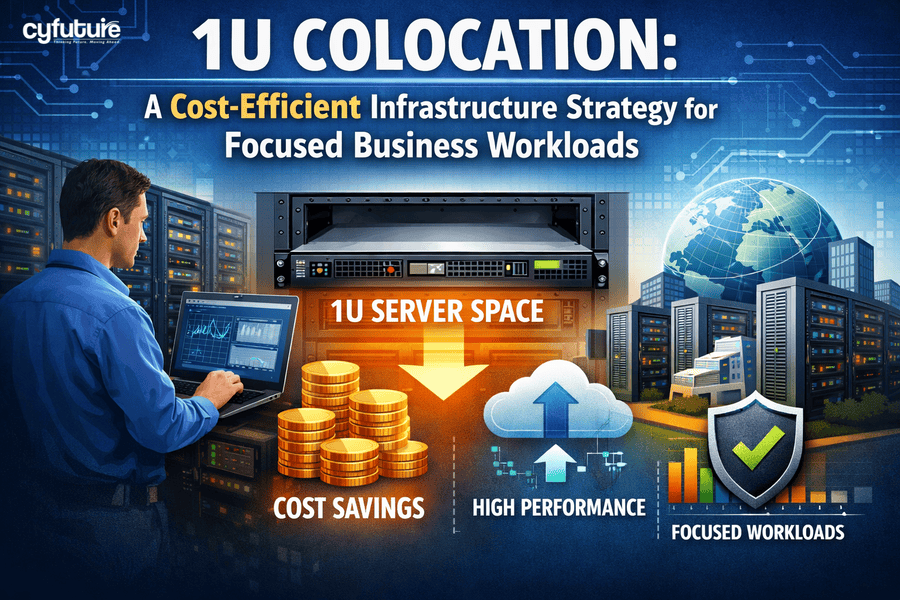
One of the strongest business cases for 1U colocation is cost efficiency. Instead of investing in expensive racks or long-term cloud commitments, businesses pay only for the space and power they actually use.
Key financial advantages include:
At the same time, businesses retain full ownership and control of their server, making 1U colocation a financially balanced option for cost-conscious organizations.
Unlike shared hosting or fully managed cloud environments, 1U colocation ensures that businesses retain complete authority over their hardware and software stack.
From a strategic standpoint, this allows organizations to:
For businesses with specialized workloads or regulatory constraints, this level of control directly supports operational independence and long-term planning.
Even small workloads can be mission-critical. Applications such as authentication services, financial reporting systems, or compliance databases require consistent uptime and reliability.
1U colocation facilities offer:
For business leaders, this translates into reduced downtime risk and improved service reliability, even for compact infrastructure setups.
Regulatory requirements often apply regardless of infrastructure size. Businesses operating in regulated sectors must ensure secure data handling and controlled access, even for single-server deployments.
1U colocation supports compliance by providing:
This makes it an ideal option for startups and growing businesses that must meet compliance standards without large-scale infrastructure investments.
While scalability is important, many business workloads prioritize performance consistency over elasticity. With 1U colocation, businesses can deploy high-performance hardware optimized for specific applications.
Performance benefits include:
This consistency enhances application reliability and improves end-user experience.
For many businesses, a 1U colocation server is a starting point into professional data center environments. It allows organizations to test colocation benefits before expanding into larger deployments.
Strategically, this enables:
As needs evolve, businesses can seamlessly move from 1U to multi-U or full-rack colocation without changing locations or providers.
Security risks can affect businesses of any size. 1U colocation provides enterprise-grade physical security that is often impractical to implement in small office environments.
Security advantages include:
From a business risk perspective, this significantly reduces exposure to theft, damage, or unauthorized access.
Many growing businesses operate with lean IT teams. Managing on-premise infrastructure can divert valuable time and resources away from core business activities.
1U colocation simplifies operations by:
This operational simplicity supports productivity and strategic focus.
The availability of 1U colocation across multiple data center providers gives businesses greater flexibility in choosing locations, connectivity options, and service levels.
This benefits organizations by offering:
Vendor flexibility ensures businesses can align infrastructure decisions with geographic and operational needs.
Before adopting 1U colocation, business leaders should consider:
When aligned correctly, 1U colocation becomes a targeted infrastructure investment rather than a temporary solution.
Though compact in size, 1U colocation can have a meaningful impact on business outcomes. By providing reliable, secure, and cost-effective infrastructure, it enables organizations to:
For many businesses, it represents a practical balance between flexibility and control.
1U colocation proves that effective infrastructure does not always require scale—it requires alignment with business needs. By offering enterprise-grade reliability, predictable costs, and full control in a compact form factor, 1U colocation empowers businesses to deploy focused workloads with confidence.
For startups, SMBs, and enterprises alike, 1U colocation serves as a cost-efficient, low-risk, and scalable infrastructure strategy. As digital operations continue to expand, businesses that make deliberate, need-based infrastructure decisions will be best positioned to grow sustainably.
1U colocation refers to renting a single rack unit (1.75 inches) of space in a professional data center to host your physical server. It is cost-efficient because you only pay for the minimal required space while still benefiting from enterprise-grade power, cooling, and security.
Businesses with focused workloads, such as web hosting, SaaS platforms, analytics nodes, firewalls, or specialized applications, should consider 1U colocation—especially if they want full hardware control without maintaining an expensive in-house server room.
1U colocation offers greater hardware control, predictable long-term costs, and better performance stability for dedicated workloads. Cloud hosting, on the other hand, provides fast scalability and zero hardware management but may become costly for constant workloads.
Most providers offer:
Redundant power (A+B feeds)
High-speed network connectivity
24/7 monitoring & physical security
Advanced cooling systems
Remote hands support
These features ensure high uptime and reliable infrastructure for critical workloads.
Costs typically range from $40 to $150 per month, depending on bandwidth, power allocation, location, and add-on services. Premium facilities or higher power requirements may increase pricing.