 1165 Views
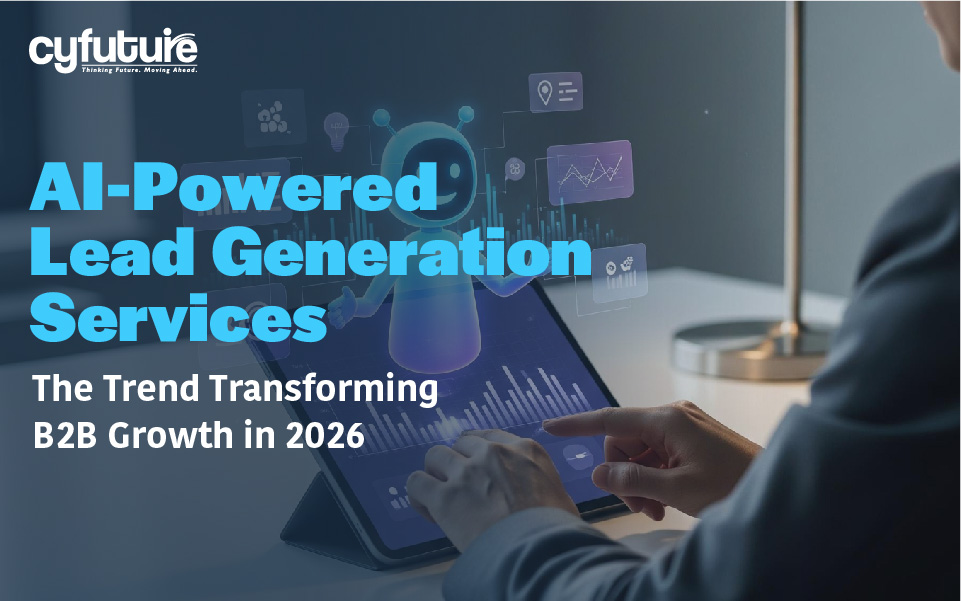
In today’s competitive digital landscape, businesses rely more than ever on lead generation services to fuel their sales pipelines and maintain consistent growth. But 2026 has marked a clear shift: traditional lead-generation methods are no longer enough. With rising customer expectations, data privacy changes, and oversaturated marketing channels, companies are turning to a new, transformative trend—AI-powered lead generation services.
Artificial intelligence is now at the core of modern B2B and B2C acquisition strategies, enabling companies to automate prospecting, personalize outreach at scale, and dramatically increase conversion rates. In this blog, we’ll explore how AI is reshaping lead generation, the tools driving this change, and how your business can leverage AI-powered lead generation services to stay competitive.
Every year, new marketing strategies emerge, but few create an impact as significant as AI. The trend’s momentum comes from a combination of market needs and technological advancements.
Paid ads cost more. Organic reach continues to decline. Buyers are more selective.
Traditional lead generation services—manual cold calling, list buying, generic email blasts—have become less effective and more expensive.
In the past, AI tools were limited to large enterprises. Now, even small businesses can access advanced features such as predictive analytics, automated workflows, and intelligent lead scoring.
Prospects expect personalized experiences. AI enables businesses to tailor messages to each individual based on behavior, demographics, and intent, making lead engagement more relevant and effective.
AI-powered tools pull live behavioral and intent data, allowing businesses to identify which prospects are ready to buy now, rather than waiting for outdated lists.
These shifts have made AI-powered lead generation services one of the most important marketing investments for 2026.
AI-powered lead generation services combine artificial intelligence, automation, and data analytics to capture, qualify, and nurture leads more efficiently than traditional methods.
These services typically include:
By automating repetitive tasks and improving accuracy, these services help companies increase ROI while reducing manual workload.
AI isn’t just a trendy add-on—it revolutionizes every stage of the lead generation funnel.
AI chatbots can engage visitors 24/7, answer questions, guide them through the buyer’s journey, and collect lead information instantly.
Unlike static forms, AI chatbots:
This increases lead capture rates significantly.
Predictive models analyze thousands of data points—industry, behavior, past interactions, browsing patterns—to determine which leads are most likely to convert.
This helps sales teams:
AI tools automate cold outreach with highly personalized messaging. Today’s AI can:
This leads to higher open and reply rates.
AI monitors search behavior, signals, and digital footprints to identify prospects who are actively researching your solution.
This allows businesses to target leads when they’re most interested.
AI uses behavioral triggers to send personalized messages at the perfect time.
For example:
The outcome? Higher conversion rates and better customer experiences.
Adopting AI in your lead generation strategy brings measurable improvements across your marketing and sales operations.
By automating research, outreach, and qualification, AI cuts down expensive manual labor and wasted ad spend.
AI evaluates leads based on data, not assumptions. This ensures your sales team only focuses on prospects who are ready to convert.
AI chatbots and automated workflows respond instantly—critical in an era where prospects expect immediate answers.
AI analyzes customer behavior to deliver personalized experiences, increasing the likelihood of conversion.
AI systems can handle thousands of leads simultaneously—something a human team simply can’t do.
AI connects CRM, marketing automation tools, and analytics to ensure both teams work with accurate, updated information.
While dozens of tools exist, several are dominating the industry due to their advanced AI capabilities:
These tools empower businesses to create a fully automated lead-generation ecosystem.
SaaS businesses use AI to identify which trial users are most likely to convert based on feature adoption and engagement metrics.
E-commerce stores deploy AI chatbots to answer customer questions, recommend products, and capture email leads automatically.
Manufacturing and IT companies use intent data tools to target businesses actively researching their solutions.
Marketing agencies implement AI email automation to run large-scale, personalized cold-email campaigns with minimal human effort.
The rise of AI is only the beginning. Over the next few years, lead generation services will evolve with even more advanced capabilities:
Instead of chatbots, businesses will deploy lifelike AI sales reps capable of engaging in real conversations.
Smart speakers and voice assistants will capture leads directly from voice searches.
AI will forecast each prospect’s unique journey and automatically route them through a customized funnel.
AI will encourage users to voluntarily share insights by providing more interactive, value-driven experiences.
Future systems will autonomously:
Businesses adopting AI early will lead in market share and efficiency.
When selecting a service provider or tool, consider these factors:
Does it integrate with your CRM (Salesforce, HubSpot, Zoho)?
Does it reduce enough manual work to justify the investment?
Ensure the tool follows GDPR, CCPA, and other privacy standards.
Can you tailor workflows, scoring models, and content?
Will the tool handle future growth?
Savings on labor + increased conversions should exceed the subscription cost.
To get the most out of AI-powered lead generation services, follow these best practices:
Define measurable goals: more leads, higher conversions, or faster response times.
AI performs repetitive tasks, freeing your team to build relationships.
AI performs best with accurate and up-to-date data.
Use A/B testing to refine messaging and workflows.
Human creativity and strategy still matter—AI simply makes them more powerful.

AI-powered lead generation services are no longer optional—they’re a necessity in 2026. Businesses that adopt AI will enjoy:
From chatbots and predictive scoring to automated outbound campaigns and intent data analysis, AI is streamlining every phase of the lead generation funnel.
If you want your business to stay ahead in a crowded digital market, now is the time to incorporate AI-powered lead generation services into your strategy.